
Warsaw, Poland
The capital of the Polish state established in 1918, Warsaw was a major center of Jewish culture and home to the largest Jewish community in Europe with over 350,000 people--around 30 percent of the city's total population.
Warsaw was occupied by the Nazis on September 29, 1939 and fell under the administration of the Generalgouvernement. Anti-Jewish measures were immediately implemented. The Warsaw Ghetto was established in October 1940, when some 400,000 Jews from Warsaw and surrounding communities were condensed into an area of 1.3 square miles. An estimated 83,000 ghetto inhabitants died of starvation and disease.
Deportations sparked the largest Jewish uprising against the Nazis during the war, the 1943 Warsaw Ghetto Uprising. Beginning in mid-1942, approximately 300,000 Jews were deported to the killing center at Treblinka or killed in the ghetto. In the spring of 1943, a group of armed resistance fighters in the Warsaw Ghetto (the Jewish Fighting Organization, or ZOB) mounted a month-long insurgency as Nazi troops attempted to round up and deport the remaining inhabitants in the ghetto. During the uprising, c. 700 Jewish fighters were able to hold out for 27 days, until the Nazis resorted to burning the ghetto to the ground, block by block.
As Soviet forces advanced towards the city in August 1944, the resistance forces of the Polish Home Army launched an attempt to liberate the city from German occupation. The Soviets did not intervene as expected and after two months of intense fighting the Warsaw Uprising was crushed by the Germans. Over 180,000 people were killed, and many civilians were deported to forced labor and concentration camps. When Warsaw was liberated by Soviet troops on January 17, 1945, the city center had been completely flattened by the Nazis and the city's prewar population of 1.3 million had been reduced to c. 174,000. Of them, only c. 11,500 were Jewish.
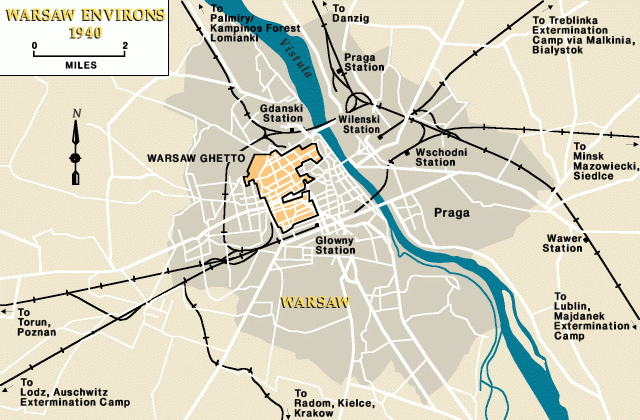
Warsaw, Poland with Warsaw Ghetto indicated, 1940.

