
War on the horizon

Paula Burger
In August 1939, Nazi Germany and the Soviet Union sign a non-aggression agreement, declaring that neither country will attack the other. An unpublished addendum to the agreement, however, lays out German and Soviet spheres of influence in Eastern Europe, essentially carving up the countries that lay between Germany and the USSR and dividing them between the two powers. The first country to fall prey to this scheme is Poland, which is invaded by Germany a week later, on September 1. The Soviet Union follows suit on September 17, occupying the eastern part of Poland, including Novogrudek.
The Soviet takeover is followed by immediate measures to transform the country into a Communist state. The German occupation pushes a steady stream of refugees from western Poland flowing east through Novogrudek, bringing stories of Nazi crimes against Jews. Aware of Nazi antisemitism, most of the region’s Jews are relieved to be under Soviet control.
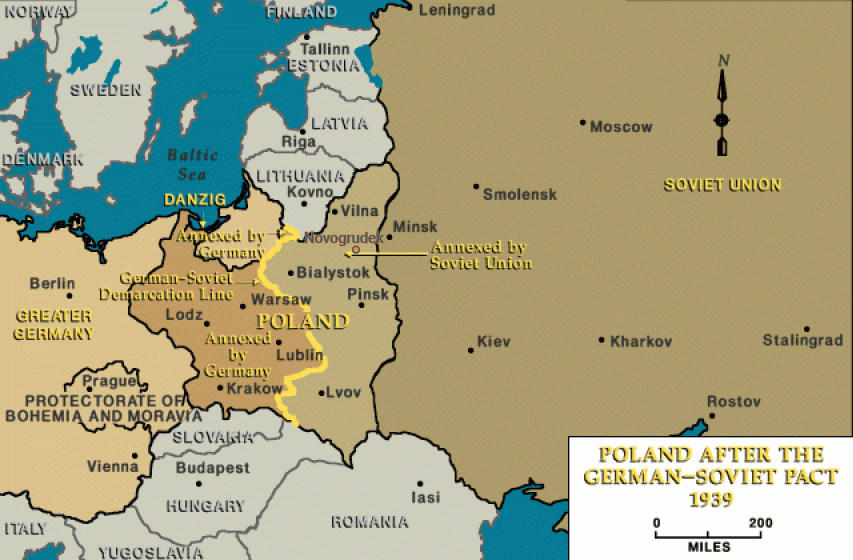
Poland after the German-Soviet Pact of 1939
Transcript
Paula Burger: Well for us, the war broke out somewhere when the Nazis invaded Poland, in ’39. But for us, it didn’t come to us until later, and we would have, I would hear my parents talk about people that they would call refugees. The people they would refer to as refugees were people who came from Poland like Warsaw, Lodz, or somewhere from the big cities of Poland because the war didn’t get—we were further into the interior, towards Russia. It’s probably, maybe not unlike Denver to people from New York, or Chicago, or LA. The town I lived [in] probably was the size of like Colorado Springs, it was—it had a university and a lot of yeshivas, and um, I think the poet laureate of Poland came from there, so it was kind of—but it wasn’t like a big city, so for us it came slower and people had come—run away from the larger cities.
"The people they would refer to as refugees were people who came from Poland like Warsaw, Lodz, or somewhere from the big cities of Poland"
USC Shoah Foundation Visual History Archive, Interview 10913
Paula Burger's Timeline
-
Europe's Jewish population is c. 9.5 million
This number represents 1.7% of the total population of Europe, and accounts for >60% of the world's Jewish population. Most Jews are in eastern Europe: Poland is home to 3.3 million Jews, some 2.5 million Jews live in the USSR, and around 756,000 Jews live in Romania. The Jewish population of the Baltic states of Latvia, Lithuania and Estonia numbers c. 255,000. In central Europe, Germany is home to c. 523,000. Some 445,000 Jews live in Hungary, 357,000 in Czechoslovakia, and 191,000 in Austria. There are also large Jewish communities in Great Britain (300,000), France (250,000, and the Netherlands (156,000). Some 60,000 Jews live in Belgium. The Scandinavian countries are home to c. 16,000 Jews. In the South, the Jewish community in Greece numbers c. 73,000. Yugoslavian Jews number c. 68,000, Italy and Bulgaria each have communities of c. 48,000.

-
Paula Burger is born in Novogrudek, Poland
Wolf Koladicki and Sarah Koladicki welcome their first child and give her the name Pola Koladicki. She will later change the spelling of her first name to Paula, and take the name of her husband when she marries.
-
U.S.S.R. and Nazi Germany agree to non-aggression pact
Germany and the Soviet Union negotiate a non-aggression pact. This agreement, often called the Molotov-Ribbentrop pact after its chief negotiators, divides eastern Europe between the Nazi and Soviet powers and results in the partition of Poland.
-
Nazi Germany invades Poland, sparking World War II
Nazi forces invade and swiftly defeat Polish forces using the "Blitzkrieg"--a rapid and combined forces attack. Within days, Great Britain and France declare war on Germany, marking the beginning of World War II.
-
U.S.S.R. invades Poland
The Soviet military occupies eastern Poland, as secretly agreed with Germany in the non-aggression pact signed by the two countries on August 23, 1939 (Molotov-Ribbentrop pact).
-
Nazi invasion of the U.S.S.R.
Nazi and Axis forces launch the invasion of the Soviet Union under Operation "Barbarossa," in violation of the 1939 non-aggression pact between Germany and the Soviet Union. During the eastward push, Einsatzgruppen massacre Jews, Roma, and others behind the front.
-
Novogrudek occupied by German forces
The town, located in the eastern part of Poland (today Belarus), has been under Soviet control since 1939. With the German occupation, anti-Jewish measures and restrictions are immediately introduced.
-
Bielski partisan group forms
After their parents and siblings are murdered by Germans in their village of Stankiewicze, brothers Tuvia, Asael, Aharon, and Zus Bielski form a Jewish partisan group under command of the eldest brother, Tuvia Bielski. Throughout 1942-1943, the Bielski partisans grow from a small group into a larger community ultimately comprising more than 1,200 Jews living in the forests between Lida, Novogrudek, and Minsk.
-
Nazis murder 4,000 Novogrudek Jews and force remainder into ghetto
In an Aktion on December 7, Nazis order the Jews of Novogrudek to assemble at the courthouse. On December 8, the majority (c. 4,000-4,500 individuals, including many elderly people, women, and children) are killed in a mass shooting. Skilled laborers and their families (c. 1,900 people) are spared and are concentrated in a ghetto, together with Jews from surrounding communities.
-
Nazis initiate Operation “Reinhard”
Named after RSHA chief Reinhard Heydrich, Operation "Reinhard" is central to the Nazi plan for the "Final Solution" and foresees the extermination of the Jewish population in the Generalgouvernement. Approximately 1.7 million Jews are systematically murdered in mass shooting operations and in killing centers at Belzec, Sobibor, and Treblinka.
-
Deadline for "Final Solution" in occupied Poland
Heinrich Himmler orders that by December 31, 1942 there should be no Jews remaining in the Generalgouvernement, calling for a "total purge" to secure the German Reich.
-
Paula Burger joins her father in partisan camp
After a daring escape from the ghetto hidden inside of an empty water barrel, Paula and her brother Isaac are reunited with their father, Wolf, and are introduced to life in the Bielski partisan camp.
-
Second Nazi mass execution of Jews from Novogrudek and nearby communities
Between 3,000 and 5,000 people are murdered, including most of the inhabitants of Novogrodek ghetto.
-
Third Novogrudek massacre
Nazis murder some 510 people—nearly all of the inhabitants of the Novogrudek ghetto at Pereseika. The surviving Jews are concentrated in the courthouse ghetto quarters.
-
Order to liquidate Baltic and Belorussian ghettos
Heinrich Himmler issues order to liquidate ghettos in occupied Belarus (Belorussia) and the Baltic states: Estonia, Latvia, and Lithuania.
-
Germans launch anti-partisan Operation "Hermann"
Germans deploy 52,000 soldiers to root out partisan activity in the area north of Novogrudek, surrounding the forest. They destroy some 60 settlements, killing more than 4000 people and sending c. 20,000 to forced labor in Germany. Partisan groups in the area refer to the operation as "The Big Hunt." The Bielski detachment leaves its camp in the Naliboki forest and crosses a swamp to reach the remote island of Krasnaya Gorka.
-
Jews in Novogrudek ghetto begin work on escape tunnel
Determined to escape, the c. 250 surviving Jews in the Novogrudek ghetto dig an underground passage from the ghetto to the outskirts of the town. On September 26, 1943, 232 people crawl through the tunnel. Many of them are caught by guards as they emerge, but some 170 escape into the forest and many join the Bielski partisan camp.
-
Soviet offensive breaks through German front in Belorussia
The Red Army destroys Nazi forces along the eastern front, liberating Belorussia and Ukraine and advancing westward into East Prussia. There are heavy losses on both sides, but the battle leaves German military command in the region in complete disarray.
-
Soviet forces reach Novogrudek
After reclaiming Minsk on July 4, the Red Army presses westward, reaching Novogrudek on July 8 and driving the Nazi occupiers from the city.
-
Emigration crisis for displaced persons (DPs) in Europe
Two years after the end of the war, there are still some 1 million people in displaced persons (DP) camps in Europe. Approximately 250,000 are Jews awaiting further immigration, many of whom wish to emigrate to Palestine. For many DPs, repatriation to their pre-war homes is unthinkable, but many countries--including the U.S.--still impose restrictive immigration policies.
-
US Congress passes Displaced Persons Act
At the urging of US President Truman, Congress passes the Displaced Persons Act of 1948 allowing for the entry of 100,000 DPs from Europe per year, greatly expanding the previously enforced national origin quotas. The Displaced Persons Act is amended in 1950. In total, 400,000 DPs immigrated to the US between 1948-1952, including an estimated 80,000 Jews.
-
Koladicki family leaves Germany for the United States
Paula and her family--her brother Isaac, her father Wolf, his wife Chana and their daughter Fay--board a plane in Munich bound for New York. Their final destination is Chicago, where Wolf has relatives.
-
Postwar European Jewish population estimated at 3.5 million
In 1933, Europe was home to an estimated 9.5 million Jews. By 1945, two out of every three have been killed. Poland had the largest prewar Jewish population in Europe, numbering some three million. An estimated 350,000 Polish Jews survived the war, and by 1950, only 45,000 remain in Poland. The lives lost in the Holocaust account for most of these demographic changes. For most survivors, a return to their pre-war community is unthinkable, and they seek to start a new life abroad.