
To live in Shanghai, or elsewhere?

Fred Marcus
During the course of World War II, millions of people are uprooted from their homes. Even two years after the end of the war, close to one million people still await further immigration in DP (displaced persons) camps in Europe and around the world. Despite the dire humanitarian situation, many countries continue to enforce selective immigration policies and quotas per country of origin.
Stateless refugees in Shanghai find themselves in an increasingly precarious situation during the post-war years. With the withdrawal of Japanese forces from China, domestic political tensions between the nationalist Kuomintang led by Chiang Kai-Shek and the Communist opposition led by Mao Zedong intensify. At first, fighting is restricted to rural areas in northern China, but as the Communists advance toward urban centers, refugees sense increasing urgency to leave Shanghai for a more permanent home.
The departure of Jewish refugees from Shanghai begins in early 1947. Once again, members of the refugee community find themselves in urgent pursuit of immigration options, although doors do not readily open to them. They appeal to contacts and support organizations abroad for help.
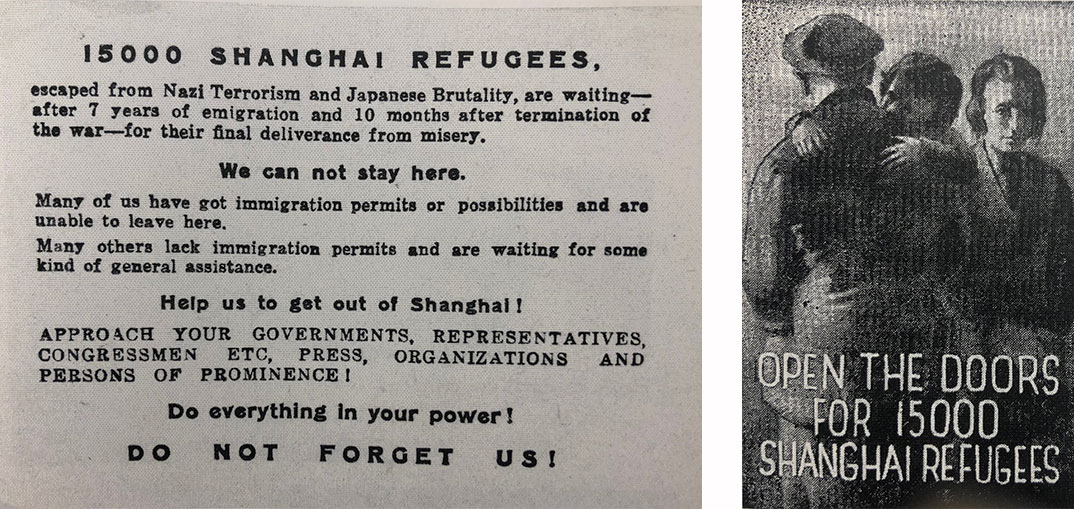
Card and sticker sent by refugees with pleas for help to family and friends in Europe
Audrey Friedman Marcus and Rena Krason, Survival in Shanghai: the Journals of Fred Marcus 1939-49. Berkeley: Pacific View Press, 2008.
Uncertain of where his future lies, Fred throws himself into the excitement of post-war Shanghai. His transition into adult life and newfound freedom is exhilarating and challenging. Sustained by the energy and excitement of these years, Fred lives largely in the moment. In October 1945, he finds work in one of the premier hotels in the city, the Cathay, where many high-ranking American military officials are housed. He is able to reside in the hotel and enjoys a comfortable lifestyle; he has a broad and growing circle of friends and acquaintances, including fellow refugees, colleagues from the hotel, journalists, aid workers and Americans stationed in the city. He adopts the name Fred in favor of his given name, Fritz.
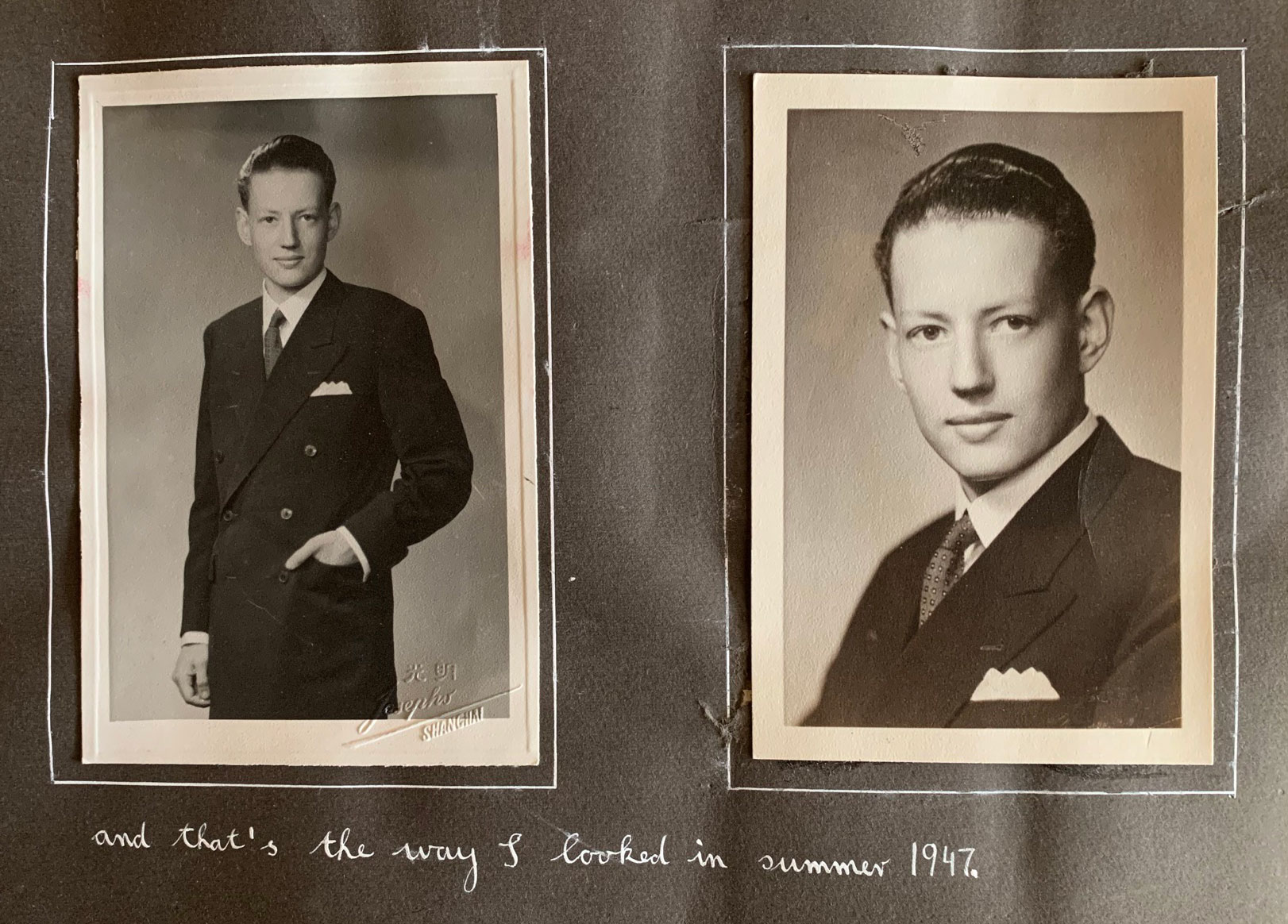
Page from Fred’s photo album, with his handwritten caption. The photographs are from 1947, but Fred assembled them into an album and added captions in English later.
Courtesy of Audrey Friedman Marcus
In 1947, Jewish refugees who are able to obtain immigration visas begin leaving Shanghai, headed for the United States, Canada, Australia, and Israel (or Palestine, prior to establishment of the State of Israel in 1948). Very few decide to return to Europe. America is a preferred destination, despite the relative difficulty of obtaining a visa.
Fred records the departures of one friend after another in his diary, but makes no serious efforts to leave himself. He seems to cling to the life he knows in Shanghai, however transient it may be. As time goes by, and as more and more of his friends depart to start new lives elsewhere, he finds himself in an existential crisis. After seeing off so many of his friends and acquaintances, including his closest friend Theo "Ted" Alexander, bound for America, Fred eventually decides to pursue a U.S. immigration visa in earnest. Initially, he hesitates, intending to save up at least $1000 to qualify for individual immigration—perhaps as a matter of pride—but in 1948 he decides to apply for immigration on a collective affidavit.
Excerpt from Fred’s unpublished autobiography
Tuesday, July 1, 1947: The biggest problem in life now is further immigration. All immigrants find themselves in a sort of psychosis, which, naturally, grips one when one sees one’s beloved friends and relatives leave one after another. In addition to this, the present conditions here are so unsettled and disorderly that one does not know what the next day will bring. Financially, I now earn less every month since the dollar is always climbing higher.
I have basically decided to go to the United States for the following reasons: 1) My entire family is moving their residence there. (…) 2) I believe that in the U.S.A. there is the possibility of great business developments, although I am aware from reports that I would have to start from the bottom. 3) I want to live in a civilization where I have equal rights and am respected. 4) I don’t want to be a stateless refugee any longer.
My chances to emigrate are at present nil. Nevertheless, I hope that I will get an affidavit through a) Miriam Stiglitz, or b) Gerhardt Abraham, or c) Uncle Martin, or when nothing else works, through d) the Joint [the American Jewish Joint Distribution Committee]. Julius Tuchler may provide a collective affidavit, but in spite of this I would prefer to get an individual affidavit, because with God’s help, I have been able to become independent from mass actions and I want to continue being so.
However, at the moment, I have taken the position of waiting.
Fred Marcus' Timeline
-
Fred Marcus born in Berlin, Germany
His parents, Samuel and Gertrud Marcus, name their son Fritz Werner Marcus. He will later change his name to Fred Marcus.

-
Jewish population in Germany is c. 523,000
The c. 523,000 Jews living in Germany at the beginning of 1933 make up less-than 0.75% of the country's total population (67 million). Approximately 80% hold German citizenship; the next largest group are Polish citizens, many of whom are permanent residents of or were born in Germany. Some 70% of the Jewish population in Germany lives in urban areas; the largest community (c. 160,000 people) is in Berlin.
-
School quotas limit the number of Jewish students
Quotas allow only 1.5 percent of high school and university students to be Jewish. Jews will be totally barred from German schools by 1938, and Jewish schools will be ordered closed in 1941.
-
Law requires registration of Jewish-owned assets
Under the "Order for the Disclosure of Jewish Assets," Jews must register all property valued at over 5,000 Reichsmark. This law sets the stage for the expropriation of Jewish property and possessions.
-
Registration of Jewish-owned businesses
Businesses owned in whole or in part by those defined as Jews under the Nuremberg Race Laws must register, which allows for the further expropriation of Jewish property by the Nazis.
-
Restriction of Jews from professions
Nazi laws restrict Jews from employment in numerous professions, including: book-keeping, real estate, money-lending, and tour-guiding.
-
Kristallnacht Pogrom
Kristallnacht--the "Night of Broken Glass"--begins the night of 9 November and continues through the next day throughout Germany, Austria, and the Sudetenland. Nazi leadership plans and coordinates the pogrom, during which more than 1,400 synagogues are burned, Jewish-owned businesses destroyed, and about 30,000 Jews are arrested and deported to concentration camps. The Jewish community is later required to pay "restitution" for the damage caused to their own property. Nazis claim Kristallnacht was a "spontaneous" response to Grynszpan's assassination of vom Rath. In the United States, the Kristallnacht attacks were front-page news. Despite widespread condemnation of the Nazi persecution of Jews, the majority of Americans did not want to welcome Jewish refugees from Europe.
-
Exclusion of Jews from German economic life
The "Order for the Exclusion of Jews from German Economic Life" prohibits Jews from owning stores or engaging in any type of commerce with goods or services. Furthermore, Jews are prohibited from managing businesses of any kind and are forced to sell their businesses to Germans.
-
Jewish children banned from public schools
Jewish attendance at German schools has been subject to a restrictive quota since April 1933. Though most Jewish students had already left German public schools due to antisemitism, this law formally expells Jewish children from schools.
-
Fred and Semmy Marcus depart Berlin bound for Shanghai
With only a few personal belongings, some family heirlooms, and ten marks each in cash in their pockets, Fred and Semmy Marcus leave Berlin. They pass through Munich on their way to Genoa, where they board a ship bound for China on March 29.
-
Fred and Semmy Marcus arrive in Shanghai
After an exciting and comparatively luxurious 29-day passage, Fred and Semmy Marcus arrive at Shanghai pier and are transported to refugee housing.
-
US, Canada, and Cuba deny entrance of Jewish refugees on the St. Louis
The U.S., Canada, and Cuba deny entrance to over 900 refugees aboard the St. Louis, though they possess Cuban visas. The passengers--nearly all Jewish--are forced to return to Europe. Belgium, France, Great Britain, and Holland accept the refugees, though many are later deported and murdered when the Nazis occupy Belgium, France, and Holland.
-
Japan bombs Pearl Harbor
Nazi Axis power Japan bombs the US naval base at Pearl Harbor in Hawaii, killing 2,390 soldiers and civilians.
-
US enters World War II
After the attack on Pearl Harbor, the US declares war on Japan, as do Great Britain and the other Allied powers. The Japanese military attacks British forces in Shanghai harbor and gains control of the International Settlement in Shanghai, bringing the entire city under Japanese control.
-
President Roosevelt signs Executive Order for relocation of Japanese Americans
In reaction to the Japanese attack on Pearl Harbor, Executive Order 9066 mandates the internment of Japanese Americans with the stated purpose of preventing espionage. From 1942 to 1945, US government policy requires that people of Japanese descent in the US--including American citizens--are forcibly relocated to and held in isolated camps in the US interior.
-
Nazi surrender at Stalingrad
After months of bitter fighting, the Soviet army is finally able to surround and trap German forces besieging the city. Of the nearly 250,000 troops that attacked the city in August 1942, some 90,000 surrender to the Soviets. The German defeat in the Battle of Stalingrad marks a turning point in the war; Soviet forces will now advance and push the Axis to retreat.
-
Jewish refugees in Shanghai restricted to Hongkew ghetto
Japan issues the “Proclamation Concerning Restriction of Residence and Business of Stateless Refugees”, ordering the c. 23,000 stateless refugees in Shanghai—who are overwhelmingly Jewish—to move to a designated “Restricted Sector for Stateless Refugees” in the neighborhood of Hongkew.
-
Samuel Marcus dies in Shanghai
Semmy's health has been poor since early April, and he is admitted to the hospital on April 20th. Fred is himself struggling with pneumonia and his infection keeps him from visiting his father as he fights a severe fever for 8-10 days. When Fred’s fever subsides, he learns that his father passed away on May 1.
-
D-Day: Allied invasion of France
The long awaited invasion of Nazi-occupied France by Allied forces begins with the landing of some 175,000 US, British and Canadian troops on the beaches of Normandy.
-
Death of US president Franklin Roosevelt
Following a stroke, President Franklin Roosevelt dies. Vice President Harry Truman becomes President.
-
Unconditional surrender of Nazi Germany
Nazi Germany's High Command unconditionally surrenders on 7 May to the Allies and 9 May to the Soviets. May 8 is proclaimed "Victory in Europe Day."
-
US atomic bombs destroy Hiroshima and Nagasaki
The US drops an atomic bomb on Japan's manufacturing and port city Hiroshima on 6 August. The bomb obliterates the city, killing nearly 80,000 people, mostly civilians. On 9 August, the US drops another atomic bomb on Nagasaki, killing at least 40,000 people.
-
V-J (Victory over Japan) Day: Imperial Japan surrenders
Imperial Japan announces surrender to the Allies, ending World War II. Formal surrender ceremonies follow on 2 September.
-
Emigration crisis for displaced persons (DPs) in Europe
Two years after the end of the war, there are still some 1 million people in displaced persons (DP) camps in Europe. Approximately 250,000 are Jews awaiting further immigration, many of whom wish to emigrate to Palestine. For many DPs, repatriation to their pre-war homes is unthinkable, but many countries--including the U.S.--still impose restrictive immigration policies.
-
Exodus sails for Mandate Palestine
The ship Exodus embarks from France carrying approximately 4,500 Jewish refugees bound for British Mandate Palestine. British forces prevent the ship from docking and return it to France, where refugees remain on board for over a month. British administrators enforce a strict quota on Jewish immigration at the demands of Arab leaders in Mandate Palestine.
-
US Congress passes Displaced Persons Act
At the urging of US President Truman, Congress passes the Displaced Persons Act of 1948 allowing for the entry of 100,000 DPs from Europe per year, greatly expanding the previously enforced national origin quotas. The Displaced Persons Act is amended in 1950. In total, 400,000 DPs immigrated to the US between 1948-1952, including an estimated 80,000 Jews.
-
Fred Marcus departs Shanghai bound for San Francisco
Nearly ten years after his arrival in April 1939, Fred Marcus boards the S.S. Joplin Victory in Shanghai Harbor, headed for San Francisco and a new life.
-
Communist forces led by Mao Zedong reach Shanghai
Rural China has been in the midst of a civil war between the Chinese nationalist Kuomintang led by Chiang Kai Shek and the Communist opposition led by Mao Zedong since the end of Japanese occupation in 1945. As Communist forces under Mao Zedong reach Shanghai, a Communist takeover in China is all but certain.
-
The Jewish population of Europe is an estimated 3.5 million
In 1933, Europe was home to an estimated 9.5 million Jews. By 1945, two out of every three have been killed. Before the war, Poland had the largest Jewish population in Europe, numbering some three million. An estimated 350,000 Polish Jews survived the war, and by 1950, only 45,000 remain in Poland. The lives lost in the Holocaust account for most of these demographic changes. For most survivors, a return to their pre-war lives is unthinkable, and they seek to start a new life abroad.