
After liberation

Jack Adler
In the days and weeks after their liberation, many former concentration camp prisoners succumb to the effects of malnutrition and disease resulting from their treatment by the Nazis. Jack is 16 years old and completely emaciated. Early on, his condition is so poor that doctors do not expect him to make it, but he pulls through.
Jack spends three months in the hospital, regaining his health and his strength. Upon his discharge, he lives in a displaced persons camp with other Jewish survivors.
Transcript
Jack Adler: The hospital was in a-- what, later on, became a displaced-persons' camp, in the city of Foehrenwald, Germany. I think, prior to the liberation, it was a work camp for-- where they provided housing for people to live who worked around the area. The doctors-- very interesting medical team. I remember-- as I stated, I was suffering from-- beside malnutrition-- I weighed 66 pounds-- I-- I had high fever. I had double pneumonia. So the nurses wrapped me in-- in sheets dipped in ice water and alcohol, to draw out the temperature.
But I remember the rounds, the daily rounds, were-- were being made by three doctors. One was an American, one was a Hungarian Nazi-- they call them [? Milos-- ?] and one was a German doctor. And I remember, they make-- you know, there at the beginning, when I was hospitalized, they-- you had your chart at the foot of the bed. So they would look at the chart, talk to each other--
And I could barely-- I was in such high fever-- I had such high fever, I couldn't keep my eyes open, but I could see, barely, through them. And then they look, and they confer, and they go like this. In other words, he's a goner. I said, [INAUDIBLE] that’s what you think. [LAUGHS] More or less. You know.
So I was pretty bad off. I was hospitalized, oh, for about 90 days-- three months. And I got excellent medical care, by the way. The doctors were good. The nurses were good. We received good food and so on.
"I weighed 66 pounds."
USC Shoah Foundation Visual History Archive, Interview 18433
Excerpt from Jack's memoir, Y? A Holocaust Narrative:
I was in the hospital for ninety days. I was a skeleton when I arrived, but by the time I was released, I had put on some weight from fluids and food. I slowly began to regain my strength; it was like learning to live again after spending what felt like an eternity in a walking death as a soulless slave. First, I found my composure and ability to think clearly while bedridden. Then, I could move and talk. Finally, I took my first steps as a free man and left the bed, moving about the room and eventually outside of it. After a while I could move about in the main ward that was used for recreation. We patients played cards, checkers, and chess, anything to kill the time and feel like people again.
[...]
I lived in the hospital within the camp from the time of my liberation until sometime around September of 1945. The camp itself then became my home and I lived there until November of 1946. I was seventeen when I left. That year or so was a blur as I rejoined something of a makeshift society. I didn’t feel like I was home or that I belonged there, but I was safe and well-fed, and that was enough for someone who had been denied the basic requirements of humanity for so long.
[...]
I developed friendships, but nothing in terms of lifelong loyalties or remembrances. Our social skills had been stolen and, as much as we rejoiced in our freedom and the reclamation of our names, we still struggled (at least I did) with getting to truly know one another.
At the end of the war, hundreds of thousands of Jewish refugees find shelter in Allied DP camps in Germany, Austria and Italy. In June 1945, Foehrenwald, located just south of Munich near the town of Wolfratshausen, established specifically for Jewish refugees and is one of the largest such camps. By early 1946, there are more than 5,000 Jewish refugees living here. Some want to return to their homes, but many are waiting for an opportunity to leave Europe and start new lives in Mandate Palestine, the United States, or Australia. Jack has no interest in returning to Poland, a sentiment underscored by news of attacks on Jewish survivors there.
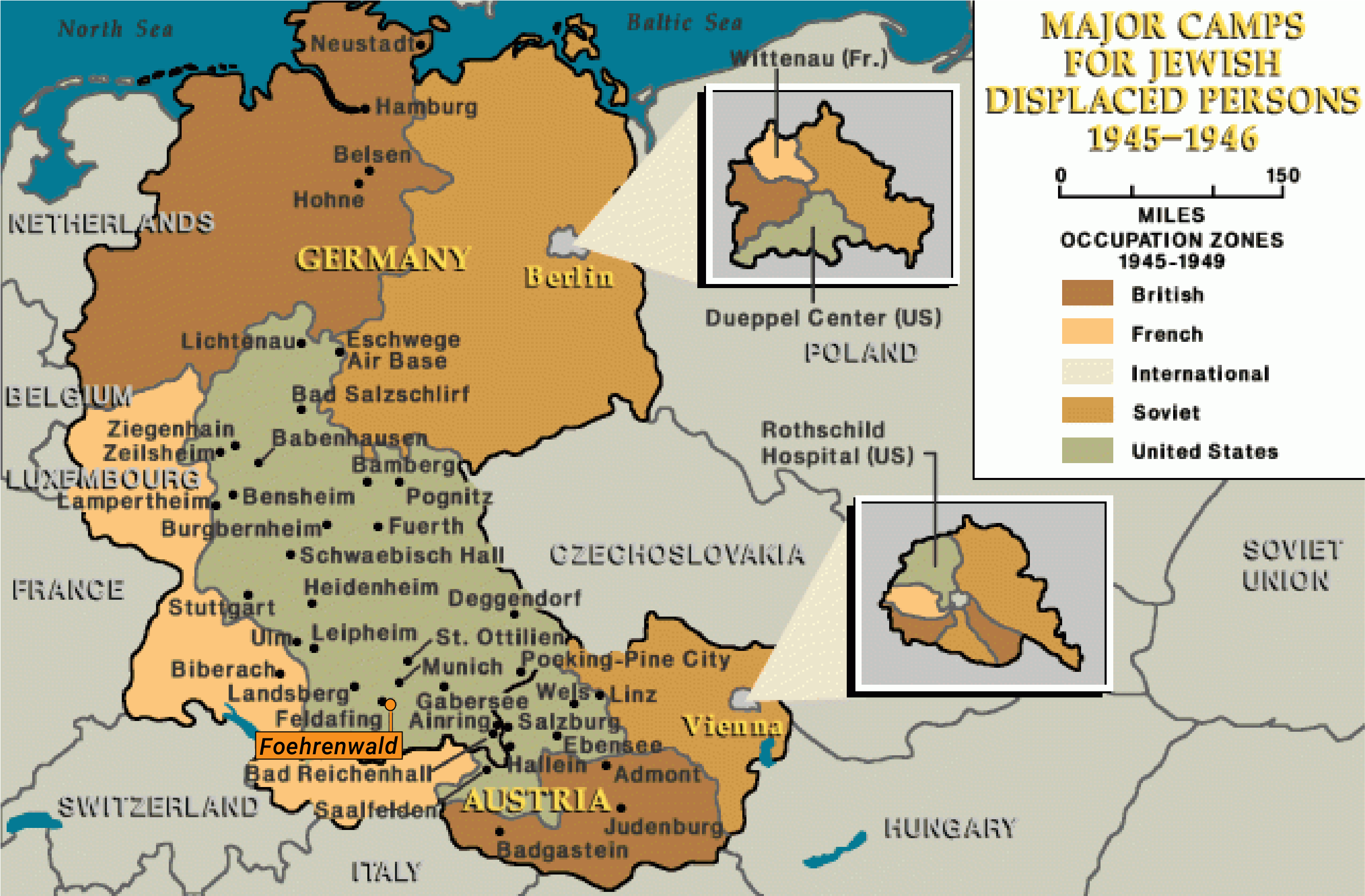
Displaced persons’ camps, 1945-46. Foehrenwald is indicated.
Transcript
Interviewer: Jack, the years-- five, six years of life in two ghettos and two camps, witnessing the atrocities around you, the-- your family dying around you, all these things happening around you, what kept you going? What-- what-- what, inside of you, kept you going?
Jack Adler: I tried-- I tried to figure this out. But I think, subconsciously, the fact that, as we arrived at Auschwitz-Birkenau and we were being separated, my sisters from my father and me, and my father told us [PAUSES FOR 5 SECONDS] [CRYING] that we'll meet back home, and not knowing what happened to him or to my sister-- it kept you going-- yes, you're-- you're going to survive. I'm going to do that, you know?
"... and my father told us that we'll meet back home ..."
USC Shoah Foundation Visual History Archive, Interview 18433
During the past six years, from the age of 10 to the age of 16, Jack has endured inconceivable hardship and persecution. The one thing that helped him persevere was hope: that the ordeal would pass, that they would survive, that he would be reunited with his family.
Excerpt from Jack's memoir, Y? A Holocaust Narrative:
Even though all of us found ourselves in a hopeless situations [sic], the one thing the Nazis couldn’t take away was what was in our heads, and for survival purposes or techniques, you have to have a positive mental attitude. Very few people who gave up hope survived. Suicide is a permanent solution to a temporary problem. I just dealt with what was happening to me. My positive mental attitude came from my family. I wanted to see them again.
Jack searches the lists of survivors compiled by the International Red Cross and posted in the camp. He learns that his father died in Dachau just before the end of the war, and his sister Ester perished in the concentration camp Bergen-Belsen, where she was sent from Auschwitz.
He is the only survivor of his immediate family, and one of only five members of his extended family to survive.
Transcript
Interviewer: --what is your understanding of what took place with your father?
Jack Adler: Well, he-- he continued to work at the same place. What happened eventually-- and I was unaware of it-- just a few days before the war ended, he was sent into the main camp of Dachau, as well, but he probably-- well, he did die there, because I found documentation to that effect after the war.
As a matter of fact, I found it in the Jewish paper in New York, The Forward, believe it or not. They listed names. It's unbelievable. So he just died, I would think, of malnutrition, primarily.
Interviewer: And do you-- do you know how-- what-- what the date was, and--
Jack Adler: They published the date-- March 13, 1945, which would be about six weeks before the war ended.
Interviewer: So six weeks prior to liberation.
Jack Adler: Prior to liberation.
Interviewer: How about other family members--
Jack Adler: Well, my sister-- I found out after the war, my older sister, she died in the camp of Bergen-Belsen concentration camp.
Interviewer: From what?
Jack Adler: Probably the same thing. Most of them who died-- oh, of course, there were many tortured and so on. But those who worked usually died from malnutrition-- you know, starvation.
Interviewer: Aunts, uncles, cousins--
Jack Adler: I have-- as I said, there were five survivors, only one cousin from my father's-side family, and then a-- a cousin who went through the camps.
My aunt, who was my father's sister, she was the only one. Her family did escape to Russia, I mentioned briefly before. And they-- a boy of theirs died. They had a young boy died. And I don't know the circumstances how.
And he and my aunt and uncle, and a daughter who lives in Israel now, they survived. And right after the war, they went back to Poland. They had a candy factory in the city of Kalisz, Poland. And they went back to claim their property, after the war, in Poland. And they were told they have 24 hours to leave Poland, or they will finish what Hitler failed to do.
So they escaped. They went to West Germany and, from West Germany, to Israel. This was after the war.
Interviewer: And how many of your family members perished during the war?
Jack Adler: From our immediate and extended family of 83, five survived.
"From our immediate and extended family of 83, five survived."
USC Shoah Foundation Visual History Archive, Interview 18433
Jack Adler's Timeline
-
Jack Adler is born in Pabianice, Poland
Yakuv Szlama [or Szlomo] Adler (later: Jack Adler) is born to Cemach and Faiga Adler in Pabianice, a small city on the outskirts of Lodz in western Poland.

-
Europe's Jewish population is c. 9.5 million
This number represents 1.7% of the total population of Europe, and accounts for >60% of the world's Jewish population. Most Jews are in eastern Europe: Poland is home to 3.3 million Jews, some 2.5 million Jews live in the USSR, and around 756,000 Jews live in Romania. The Jewish population of the Baltic states of Latvia, Lithuania and Estonia numbers c. 255,000. In central Europe, Germany is home to c. 523,000. Some 445,000 Jews live in Hungary, 357,000 in Czechoslovakia, and 191,000 in Austria. There are also large Jewish communities in Great Britain (300,000), France (250,000, and the Netherlands (156,000). Some 60,000 Jews live in Belgium. The Scandinavian countries are home to c. 16,000 Jews. In the South, the Jewish community in Greece numbers c. 73,000. Yugoslavian Jews number c. 68,000, Italy and Bulgaria each have communities of c. 48,000.

-
Dachau concentration camp established
Hitler's paramilitary SS (Schutzstaffel) establish the first concentration camp near Dachau for political opponents of the regime. Dachau remains in operation from 1933-1945. Over 200,000 people are imprisoned and estimated 41,500 are murdered during this period.
-
Polish Jews number c. 3.3 million
Jews have been living in Poland for 800 years. On the eve of World War II, Polish Jews constitute the largest Jewish community in Europe, accounting for 10% of the country's total population.
-
U.S.S.R. and Nazi Germany agree to non-aggression pact
Germany and the Soviet Union negotiate a non-aggression pact. This agreement, often called the Molotov-Ribbentrop pact after its chief negotiators, divides eastern Europe between the Nazi and Soviet powers and results in the partition of Poland.
-
Nazi Germany invades Poland, sparking World War II
Nazi forces invade and swiftly defeat Polish forces using the "Blitzkrieg"--a rapid and combined forces attack. Within days, Great Britain and France declare war on Germany, marking the beginning of World War II.
-
Nazi forces occupy Lodz and Pabianice, Poland
Invading German troops reach the city of Lodz and nearby Pabianice. They immediately introduce strict measures restricting the freedom of the Jewish population, in particular.
-
U.S.S.R. invades Poland
The Soviet military occupies eastern Poland, as secretly agreed with Germany in the non-aggression pact signed by the two countries on August 23, 1939 (Molotov-Ribbentrop pact).
-
Concentration of Polish Jews into ghettos ordered
Nazi officials order the concentration of Polish Jews in designated, often enclosed districts in major population centers in preparation for their deportation and murder. Ghettos are established throughout Nazi-occupied Poland.
-
Annexation of western Poland
Following the Nazi occupation of Poland, territories in the western part of Poland are annexed to Germany. Danzig-West Prussia and Warthegau are incorporated as new provinces of the Reich; the provinces of East Prussia and Silesia are expanded to incorporate newly gained Polish lands.
-
Generalgouvernement established in Nazi-occupied Poland
Nazis establish civilian administration over areas of Poland under German control that are not annexed to the Reich. The "Generalgouvernement" under the autocratic rule of Governor General Hans Frank encompasses four districts: Warsaw, Lublin, Krakow, and Radom.
-
Pabianice Ghetto established
Beginning in November 1939, Jews residing in wealthier areas of Pabianice are ordered to leave their homes, which are intended for Germans. In February 1940, the Jewish population is condensed into a designated area of the town. Jews are not permitted to leave the ghetto, the perimeter of which is indicated by signs.
-
Germanization of names in incorporated Poland
In areas of Poland under German administration, the names of Polish cities in the newly annexed territories are Germanized. Lodz is therefore also known as "Litzmannstadt."
-
Lodz ghetto established
Approximately 164,000 Jews are concentrated in a ghetto in the Polish industrial city of Lodz. They perform forced labor for the Nazi war effort, living under squalid conditions of severe overcrowding and insufficient sanitation, food and water.
-
Lodz ghetto sealed
The Lodz ghetto is sealed off from the rest of the city with barbed wire and fencing. Passage by Jews between ghetto and outside world is strictly controlled. Inside the ghetto, residents are forced to work in factories producing goods for the Nazi war effort. Many die of starvation and disease.
-
Jews deported from Lodz ghetto to Chelmno
Nazi forces and collaborators begin the deportation of Jews from the Lodz ghetto to the Chelmno killing center, where deportees are gassed in vans. Approximately 65,000 Jews are ultimately deported and murdered.
-
Wannsee Conference on the "Final Solution"
Leading Nazi officials convene at Wannsee to plan and implement the “Final Solution of the Jewish Question." At this meeting, operational preparations for the extermination of European Jewry are outlined.

-
Deadline for "Final Solution" in occupied Poland
Heinrich Himmler orders that by December 31, 1942 there should be no Jews remaining in the Generalgouvernement, calling for a "total purge" to secure the German Reich.
-
Nazi surrender at Stalingrad
After months of bitter fighting, the Soviet army is finally able to surround and trap German forces besieging the city. Of the nearly 250,000 troops that attacked the city in August 1942, some 90,000 surrender to the Soviets. The German defeat in the Battle of Stalingrad marks a turning point in the war; Soviet forces will now advance and push the Axis to retreat.
-
First prisoners arrive in Kaufering concentration camp
The first concentration camp at Kaufering is established with the arrival of 1,000 Jewish Hungarian men from Auschwitz. Kaufering will eventually become the largest subcamp complex in the Dachau system, with eleven camps located near Landsberg am Lech in Bavaria. It is also one of the most deadly Nazi labor camps: around half of the c. 30,000 prisoners sent to the Kaufering camps between June 1944 and April 1945 will die there. Prisoners in the Kaufering camps supply labor for the construction of underground aircraft production sites for the German airline industry, which has suffered heavy damage from Allied bombs.
-
Liberation of Majdanek
Advancing Soviet troops reach the Majdanek concentration and extermination camp. They find gas chambers and other evidence of genocide. Approximately 2,500 survivors provide details of the camp to their liberators, who document the horrors. Majdanek is the first concentration camp to be liberated by the Allies.
-
Liquidation of Lodz ghetto
Nazi forces liquidate the Lodz ghetto and deport between 60,000-75,000 Jews, as well as an unknown number of Roma, to Auschwitz-Birkenau.
-
American forces liberate Dachau
American troops reach Dachau and find approximately 32,000 inmates still alive, as well as 30 railroad cars with the corpses of prisoners who died in transport to the camp.
-
Unconditional surrender of Nazi Germany
Nazi Germany's High Command unconditionally surrenders on 7 May to the Allies and 9 May to the Soviets. May 8 is proclaimed "Victory in Europe Day."
-
US military opens hearings in Dachau trials
Between November 1945 and August 1948, the United States military holds hearings of camp guards, SS officials, and other personnel from the camps at Dachau, Flossenburg, Mauthausen, Nordhausen, Buchenwald, and Mühldorf. Of the 1,672 individuals tried before a military panel rather than a jury, some 1,400 are convicted. 297 are sentenced to death and nearly the same number to life imprisonment. Jack Adler provides testimony in advance of the trials.
-
Truman Directive prioritizes displaced persons for U.S. visas
President Harry S. Truman issues an executive order granting priority to displaced persons (DPs) for visas to enter the U.S. The order is expressly intended to help orphaned children. While it does not expand the restrictive U.S. immigration quotas, it enables some 41,000 DPs from Central and Eastern Europe – many of them Jewish – to enter the country between December 1945-July 1948.
-
Attacks on Jewish survivors in Poland
Attackers kill more than 40 Jewish survivors in Kielce, Poland. The attack spurs returning Jews to once again flee. Many find sanctuary in Allied displaced persons (DP) camps.
-
Jack Adler sails from Bremen to New York
Sailing on the S.S. Marine Marlin from northern Germany, Jack is one of 928 passengers on one of the first post-war transports of refugees from Europe to the United States. They arrive in New York harbor during the night of December 22 and disembark at Ellis Island the next day.
-
Jack Adler leaves New York for Chicago
After nearly a year and a half in New York, Jack learns that he has been placed with a foster family in Chicago and travels by train to meet them.
-
Korean War begins
After World War II, Korea is partitioned at the 38th parallel, creating a socialist state under Soviet influence in the North and a Western-style democracy in the South. In June 1950, North Korea invades South Korea, armed by the Soviet Union. Under the banner of fighting the spread of communism, the United States leads a UN coalition in the conflict against North Korea, which is backed by communist Russia and China. An armistice agreement in July 1953 puts an end to the military conflict, but the division of Korea persists until today.
-
U.S. Supreme Court ruling in Village of Skokie v. National Socialist Party of America
When a request by the National Socialist Party of America (NSPA) to hold a White Power rally in the Chicago suburb of Skokie, IL, is denied at the insistence of the town’s large Jewish community, which includes many Holocaust survivors, the NSPA files a claim for infringement of their right to free speech under the 2nd Amendment. The NSPA is represented by lawyers from the American Civil Liberties Union, who successfully argue in favor of the universality of free speech under the Constitution, maintaining that the government does not have the authority to selectively suppress voices, no matter how unpopular the opinion.