
War breaks out in Europe

Henry Lowenstein
After around six weeks in the camp at Westgate Henry is sent back to London, where he is enrolled in Hampstead Garden Parochial School. At this point, he still does not speak English, but he begins to learn quickly while immersed in a British school.
He does not have much of a chance to settle in before Nazi Germany invades Poland on September 1, 1939 sparking World War II. Within days, Great Britain enters the war against Germany. The British government orders that all children be sent out of the city to protect them from the anticipated Nazi bombing attacks on London.
Henry’s school is relocated to Whipsnade, a villlage in the countryside north of London. Henry finds himself living on a farm next to the Whipsnade zoo, the largest zoo in Europe at the time. He attends school, continues to learn English, and explores the zoo and the farm. He eventually gets a work permit and starts to work at the zoo and, later, on a local farm.
Transcript
Henry Lowenstein: Yeah! Well, I mean, if you’re in a country and you don’t speak the language, you learn fast. So obviously, we learned. And then, within about two weeks, it became obvious that the war was imminent. And the British government decided to evacuate all of London’s children. So we were evacuated, and by evacuated I mean we were told to report–this was done through the school, British kids, it just so happened, were there with us. We reported to the school, we walked from the school to a London tube–you know, the subway station, were taken to another location where we got on a bus and were then taken by bus to where we were to be evacuated to.
In my case, in the case of my school, we were evacuated to a little village called Whipsnade. Which, as it turned out, at that time, had the largest zoo in Europe affiliated with it. Whipsnade was there before, and the zoo was built on to it. We arrived, there were I think about six of us who were refugees. Six–seven or eight, maybe. Anyway, it was an interesting procedure because the zoo superintendent, who had been a captain in the British army–a veterinary captain, sat on one side of the room, the villagers sat behind him and here were all the kids to be distributed. And so we sat in this village hall, and he would say–he would call out the name of the villager, you know, the people who lived there, and he would point to a couple of kids and say, you go with them. And you, with this one. And so we were simply apportioned out, and to live with these folks.
And we–in fact there were three of us–were sent to this one place, which was a farmhouse. Lovely people. And the British government paid the equivalent I think of about a dollar and a half per week per kid for these people to feed us. Which wasn’t much. But it was the first real decent food I’d had in quite a long time, and I loved it. It was a wonderful life, we were on a farm. I’d never been on a farm before in my life. Never seen a chicken up close, and cows or anything. Not only that, but we were right adjacent to the zoo so we had full run of the zoo, with all its animals.
"I’d never been on a farm before in my life. Never seen a chicken up close, and cows or anything."
USC Shoah Foundation Visual History Archive, Interview 11470
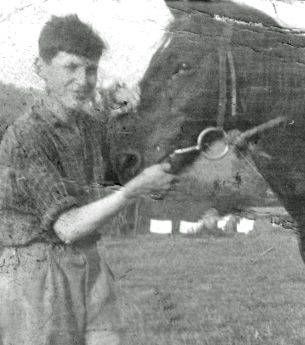
Henry on a farm in Whipsnade, c. 1940
Courtesy of John Moore, Denver Center for the Performing Arts [Permission pending]
Now that Britain is at war with Germany, Jewish refugees in England are legally considered enemy aliens, although they clearly have no allegiance to Nazi Germany. As Nazis advance into western Europe in May 1940, forcing Allied troops to evacuate from Dunkirk in France to Britain, a German invasion of England seems imminent. Henry—now 15 years old—trains with local defense efforts and the Home Guard in preparation for a German landing. Despite his desire to enlist and fight the Nazis, his alien enemy status and his essential role as a farm worker keep him from actively contributing to the war effort.
Transcript
Henry Lowenstein: We had to register as “enemy aliens.” Because we had come from Germany, technically we were enemy aliens. Now, the British knew very well that the last thing we wanted was to have anything to do with Germany. That those were our sworn enemies. But the law was, we were enemy aliens. And I was issued an alien card. I got a work permit, so I was allowed to go to work. And stayed and worked there.
And then, by this time I was 15, and very soon–now, the danger was that the Germans invade. Because of course Dunkirk had happened and the British army was kaputt, and quite frankly, I and my fellows, we trained with them, with the British, in anticipation of a German landing. And nobody had any weapons, I mean the first weapons that arrived were weapons that people in the United States sent–like sporting rifles and so on, but a great mixture, nobody had the right ammunition, and people even had lances, you know and they were going to fight with lances, which looked pretty pathetic, against a tank. But we learned how to deal with Molotov cocktails and stuff like that and dug tank traps on the intersections of the highways, and stuff like that. And I stayed with–that was first called the Local Defense Volunteers LDV, then it became the Home Guard, and I trained with them right up until the end of the war.
[...]
I actually attempted to enlist in the British Army a couple of times, but because I was working on a farm I was considered more valuable on the farm than in the fighting part, and they were, you know, I served with the Home Guard, I did my – I did what I could, but I obviously could have done more in retrospect, but I didn’t. It was the way it was.
"Because we had come from Germany, technically we were enemy aliens."
USC Shoah Foundation Visual History Archive, Interview 11470
Henry Lowenstein's Timeline
-
Hitler reconstitutes the Nazi Party
Hitler, released after 9 months in prison for treason, declares the return of the Nazi Party (NSDAP) at Munich's Bürgerbräukeller, the site of the Nazi Putsch against the democratically elected government in 1923. Hitler, who aims to gain power through elections, and then establish a Nazi dictatorship, designates himself Führer (leader).

-
Henry Lowenstein born in Berlin, Germany
Henry's parents, Max and Maria Loewenstein, name their son Ernst Heinrich Loewenstein. He is called Heinrich, and later changes his name to Henry.
-
Wall Street stock market crash
The Wall Street Crash, or "Black Tuesday," is the most devastating stock market crash in U.S. history. The crash leads to the Great Depression, which affects the industrialized world and strikes the Weimar Republic particularly hard.
-
Jewish population of Germany is c. 523,000
The c. 523,000 Jews living in Germany at the beginning of 1933 make up less-than 0.75% of the country's total population (67 million). Approximately 80% hold German citizenship; the next largest group are Polish citizens, many of whom are permanent residents of or were born in Germany. Some 70% of the Jewish population in Germany lives in urban areas; the largest community (c. 160,000 people) is in Berlin.
-
Adolf Hitler appointed chancellor of Germany
President Paul von Hindenburg appoints Hitler chancellor on the recommendation of political advisers, who believe they can manipulate Hitler for their own political purposes. During the next 18 months, Hitler and his Nazi appointees consolidate power and take over all mechanisms of governance.
-
School quotas limit the number of Jewish students
Quotas allow only 1.5 percent of high school and university students to be Jewish. Jews will be totally barred from German schools by 1938, and Jewish schools will be ordered closed in 1941.
-
Nuremberg Race Laws passed
The "Law for the Protection of German Blood and Honor" and the "Reich Citizenship Law"--known collectively as the Nuremberg Race Laws--prohibit marriage between Germans and Jews, and strip Jews of many civil rights, relegating them to second-class citizenship. Inspired by Jim Crow-era laws imposing racial segregation and prohibiting interracial marriage in the United States, these laws are later extended to the Roma people and to Black individuals.
-
Law requires registration of Jewish-owned assets
Under the "Order for the Disclosure of Jewish Assets," Jews must register all property valued at over 5,000 Reichsmark. This law sets the stage for the expropriation of Jewish property and possessions.

-
Henry Lowenstein is accepted for Kindertransport to Great Britain
The Loewensteins receive notification from the Hampstead Garden Suburb Care Committee for Refugee Children confirming Henry's place on the Kindertransport.
-
Registration of Jewish-owned businesses
Businesses owned in whole or in part by those defined as Jews under the Nuremberg Race Laws must register, which allows for the further expropriation of Jewish property by the Nazis.
-
The Evian Conference is held in France
Convened by President Franklin D. Roosevelt, the Evian Conference is designed to address increasing numbers of mostly Jewish refugees fleeing the Reich. More than 30 countries attend, but no country--with the exception of the Dominican Republic-- significantly increases its immigration quota to meet the crisis of Jewish refugees.
-
Restriction of Jews from professions
Nazi laws restrict Jews from employment in numerous professions, including: book-keeping, real estate, money-lending, and tour-guiding.
-
Decertification of Jewish doctors
An amendment to the Reich Citizenship Law (Nuremberg Race Laws of 1935) decrees that Jewish physicians will be relieved of their accreditation to practice medicine as of September 30, 1938.
-
"Jewish name" regulations
The law requires Jews to adopt a middle name--"Israel" for males, "Sarah" for females--identifying them as Jewish. Jews are required to carry identification cards documenting their heritage.
-
Invalidation of Jewish passports
German and Austrian Jews are required to surrender their passports. Those Jews who receive permission to emigrate are granted a passport marked with the letter "J" for Jude, which expires 30 days after their departure from the Reich.
-
Kristallnacht Pogrom
Kristallnacht--the "Night of Broken Glass"--begins the night of 9 November and continues through the next day throughout Germany, Austria, and the Sudetenland. Nazi leadership plans and coordinates the pogrom, during which more than 1,400 synagogues are burned, Jewish-owned businesses destroyed, and about 30,000 Jews are arrested and deported to concentration camps. The Jewish community is later required to pay "restitution" for the damage caused to their own property. Nazis claim Kristallnacht was a "spontaneous" response to Grynszpan's assassination of vom Rath. In the United States, the Kristallnacht attacks were front-page news. Despite widespread condemnation of the Nazi persecution of Jews, the majority of Americans did not want to welcome Jewish refugees from Europe.
-
Exclusion of Jews from German economic life
The "Order for the Exclusion of Jews from German Economic Life" prohibits Jews from owning stores or engaging in any type of commerce with goods or services. Furthermore, Jews are prohibited from managing businesses of any kind and are forced to sell their businesses to Germans.
-
Jewish children banned from public schools
Jewish attendance at German schools has been subject to a restrictive quota since April 1933. Though most Jewish students had already left German public schools due to antisemitism, this law formally expells Jewish children from schools.
-
British government approves the Kindertransport (1938-1940)
After the Kristallnacht pogroms, refugee aid committees in Great Britain pressure the government to relax restrictions to allow refugee children from Germany and Germany-annexed territories into the country. The "Kindertransport," or children's transport, will bring about 10,000 children, most Jewish, from Nazi territory to Great Britain from 1938 until 14 May 1940.
-
US, Canada, and Cuba deny entrance of Jewish refugees on the St. Louis
The US, Canada, and Cuba deny entrance to over 900 refugees aboard the St. Louis, though they possess Cuban visas. The passengers--nearly all Jewish--are forced to return to Europe. Belgium, France, Great Britain, and Holland accept the refugees, though many are later deported and murdered when the Nazis occupy Belgium, France, and Holland.
-
Great Britain restricts Jewish immigration to Mandate Palestine
Great Britain governs Palestine under an international mandate. Earlier, Mandate Palestine offered Jews an escape from Nazi-occupied Europe, but the British restrict their immigration under pressure from Arab leaders.
-
Henry Lowenstein leaves Berlin on Kindertransport to Great Britain
Unaccompanied, the children on this transport leave Berlin on a train to Rotterdam, Netherlands. From Rotterdam they travel by ship across the English Channel to Harwich, where they board another train bound for London.
-
Nazi Germany invades Poland, sparking World War II
Nazi forces invade and swiftly defeat Polish forces using the "Blitzkrieg"--a rapid and combined forces attack. Within days, Great Britain and France declare war on Germany, marking the beginning of World War II.
-
British government initiates Operation Pied Piper
In anticipation of the impending war with Nazi Germany, the British government orders large-scale evacuations from urban areas that might be targets of Nazi air raids. More than half of the 1.5 million people evacuated from cities throughout Great Britain are children.
-
Nazis invade Belgium, France, Luxembourg and the Netherlands
Nazi Germany invades and quickly overwhelms Belgium, much of France, Luxembourg, and the Netherlands.
-
Allied evacuation from Dunkirk
Following Germany's rapid conquest of Belgium and the Netherlands, and with the French overwhelmed, approximately 300,000 Allied troops evacuate from Dunkirk to Great Britain.
-
Battle of Britain and the "Blitz"
Great Britain under Prime Minister Winston Churchill remains defiant of Nazi aims to force British surrender. Great Britain's Royal Air Force (RAF) battles the German Luftwaffe for months during a massive bombing campaign against British strategic and civilian targets. In nightly bombing attacks on London and other British cities, thousands are killed and millions terrorized.
-
German Jews must wear yellow star
Nazi law requires all Jews in the Reich over age six to wear a badge on their clothing. This applies to Jews in Germany and all Jews living in territories annexed to Germany, including western Poland (the Warthegau), Bohemia and Moravia, and Alsace. The easily identifiable badge features a yellow six-pointed star with the word "Jew" written in the local language.
-
Wannsee Conference on the "Final Solution"
Leading Nazi officials convene at Wannsee to plan and implement the “Final Solution of the Jewish Question." At this meeting, operational preparations for the extermination of European Jewry are outlined.
-
"Factory Action" raid and Rosenstrasse Demonstration in Berlin
In the "Factory Action" of February 1943, the Gestapo conducts a major roundup of German Jews for deportation to Auschwitz. In Berlin, so-called “mixed marriage Jews” are held in special custody at the Jewish community center building at Rosenstrasse 2-4 in Berlin. A group of detainees' German/non-Jewish family members assembles outside of the building to demand information about their family members. Their protest continues until March 6.
-
D-Day: Allied invasion of France
The long awaited invasion of Nazi-occupied France by Allied forces begins with the landing of some 175,000 US, British and Canadian troops on the beaches of Normandy.
-
Allied and Nazi forces engage in "Battle of the Bulge"
Allied troops moving towards Germany are halted when Nazi forces in the Ardennes Forest in Belgium push back the US Army. The Germans' rapid advance creates a "bulge" in the front lines of combat, but their gains are only temporary.
-
Soviet occupation of Berlin
The "Battle of Berlin" begins April 20. As the Soviets fight their way street by street into the city, Nazi forces and leadership collapse in disarray. Hitler commits suicide on April 28. After three days of fierce fighting, the Reichstag--and the city of Berlin--falls to the Soviets on May 2, 1945.
-
Unconditional surrender of Nazi Germany
Nazi Germany's High Command unconditionally surrenders on 7 May to the Allies and 9 May to the Soviets. May 8 is proclaimed "Victory in Europe Day."
-
Emigration crisis for displaced persons (DPs) in Europe
Two years after the end of the war, there are still around one million people in displaced persons camps in Europe. Approximately 250,000 are Jews awaiting further immigration, many of whom wish to emigrate to British Mandate Palestine. For many DPs, repatriation to their pre-war homes is unthinkable, but many countries--including the U.S.--still impose restrictive immigration policies.
-
Korean War begins
After World War II, Korea is partitioned at the 38th parallel, creating a socialist state under Soviet influence in the North and a Western-style democracy in the South. In June 1950, North Korea invades South Korea, armed by the Soviet Union. Under the banner of fighting the spread of communism, the United States leads a UN coalition in the conflict against North Korea, which is backed by communist Russia and China. An armistice agreement in July 1953 puts an end to the military conflict, but the division of Korea persists until today.