
A brush with Ellis Island

Barbara Bandler Steinmetz
The Bandlers depart from Lisbon in May 1941 aboard the Portuguese vessel Nyassa bound for the Dominican Republic. Their first stop is another island, Ellis Island in New York Harbor. Ellis Island has been the most significant American facility to process immigrants arriving to the U.S., but during World War II it is being used as a detention facility. The Bandlers are housed in the sprawling facility’s barracks while they wait weeks for health clearances that will permit them to proceed to the Dominican Republic. The promise of freedom and a better life symbolized by the Statue of Liberty that stands across the harbor remains frustratingly out of reach.
Transcript
Barbara: We left in May of 1941. And we went on a boat-- on a ship called the Nyassa, N-Y-A-S-S-A. And that ship was the last ship that left the European continent, May of 1941. And that is a matter of record. It was the last ship. And we went in steerage.
Now the-- the trip was paid for by the Joint Distribution Committee. But-- because of course, the Jews that left Europe didn't have very much to-- very much money to take with them. And so the passage was a loan from the Joint Distribution Committee, which was to be paid back through work at a later date.
But I do remember going on the ship. And the ship was headed for New York, for Ellis Island. And all the passengers on the boat, as I said, we were in steerage. So we were-- we slept in large dormitories at the bottom of the boat. And I'm going to-- I-- I think that the boat was probably filled to the brim with anybody and everybody that just wanted to get out of the continent. So we landed in Ellis Island. I don't-- I don't know how long we were on the ship, whether it was a week or whatever.
Interviewer: What were the conditions like on the ship?
Barbara: I don't remember. I don't remember. I'm-- I'm going to guess that they were probably pretty crowded wherever-- wherever you went on-- on shipboard. I remember being-- being out on deck. But that's all I remember. But I do remember Ellis Island. We got to Ellis Island. And I'm not sure how long we were there. It might have been-- it might have been as long as two weeks. Everyone was herded into the large room in Ellis Island. It was confusing. It was noisy. What I do remember about Ellis Island is the smell. It-- there were these very strange, strange smells. And-- and that's pretty much what I remember when I initially got to Ellis Island.
When we were there, the families were separated. And this was really about the first time that my family was separated. My-- my mother slept in a dormitory of women with-- with the two of us, with my sister and myself. And my father slept in the men's dormitory. And the only time we were able to see my father was at meal times. And-- and I'm-- I can't even remember whether I actually saw him in the playground. There was a playground. And we were allowed to go out into the open for about an hour or two a day. The rest of the time, we were inside the building. And that's mostly what I remember about Ellis Island, was the playground. It must have been just wonderful for a kid to be able to get out and breathe some fresh air, because the conditions inside in Ellis Island were very crowded. And when I say that I remember the smell, it-- it must have been just a lot of stale air because there were so many people. And they were all crowded together.
"And we were allowed to go out into the open for about an hour or two a day. The rest of the time, we were inside the building. And that's mostly what I remember about Ellis Island, was the playground."
USC Shoah Foundation Visual History Archive, Interview 38619
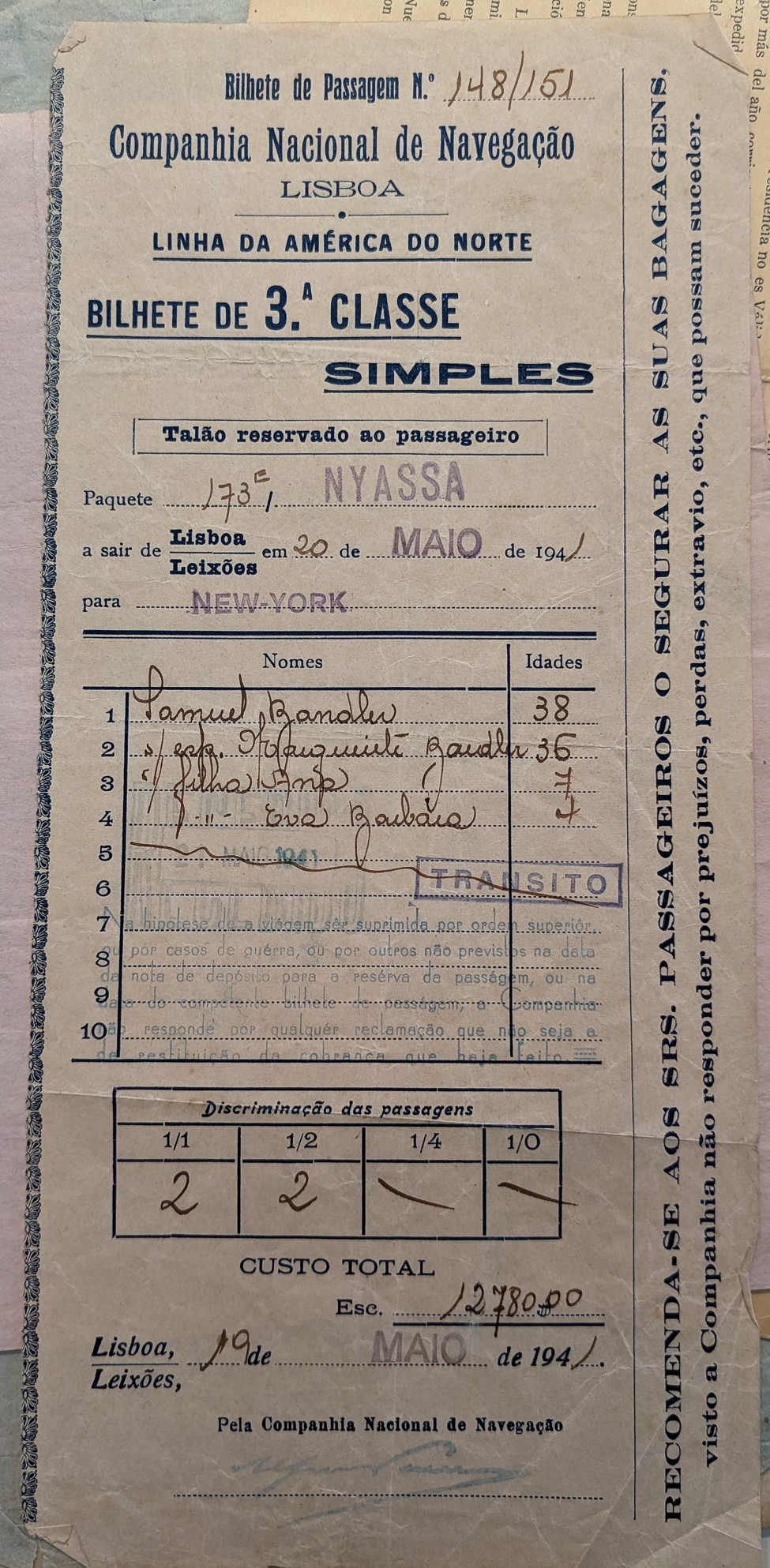
3rd Class ticket for the Bandler family’s voyage from Lisbon to New York , departing on May 20, 1941, on the Nyassa, operating on the North America Line of the Portuguese National Shipping Company [Companhia Nacional de Navegação].
Courtesy of Barbara Bandler Steinmetz
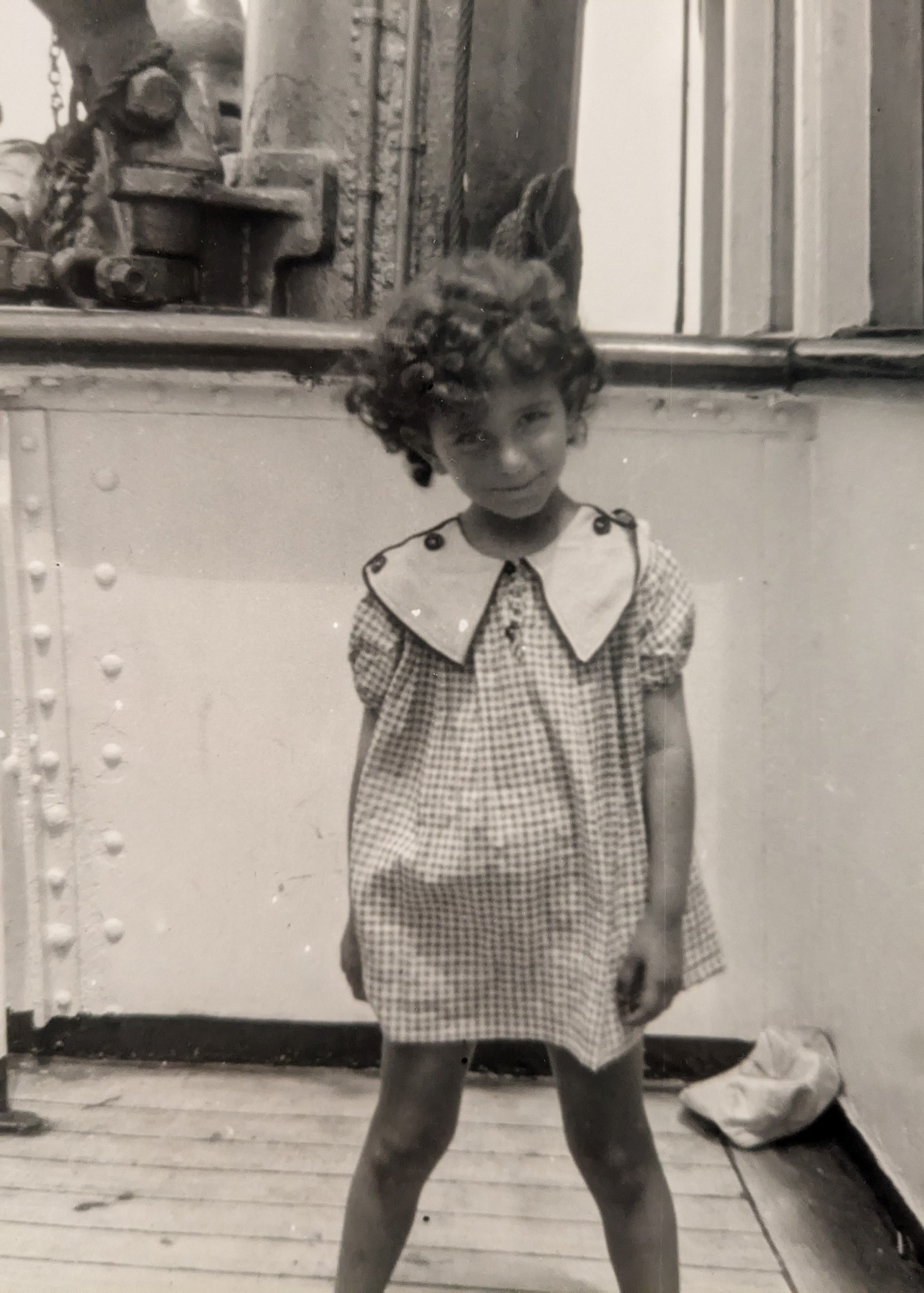
Barbara on board the Nyassa, May 1941.
Courtesy of Barbara Bandler Steinmetz
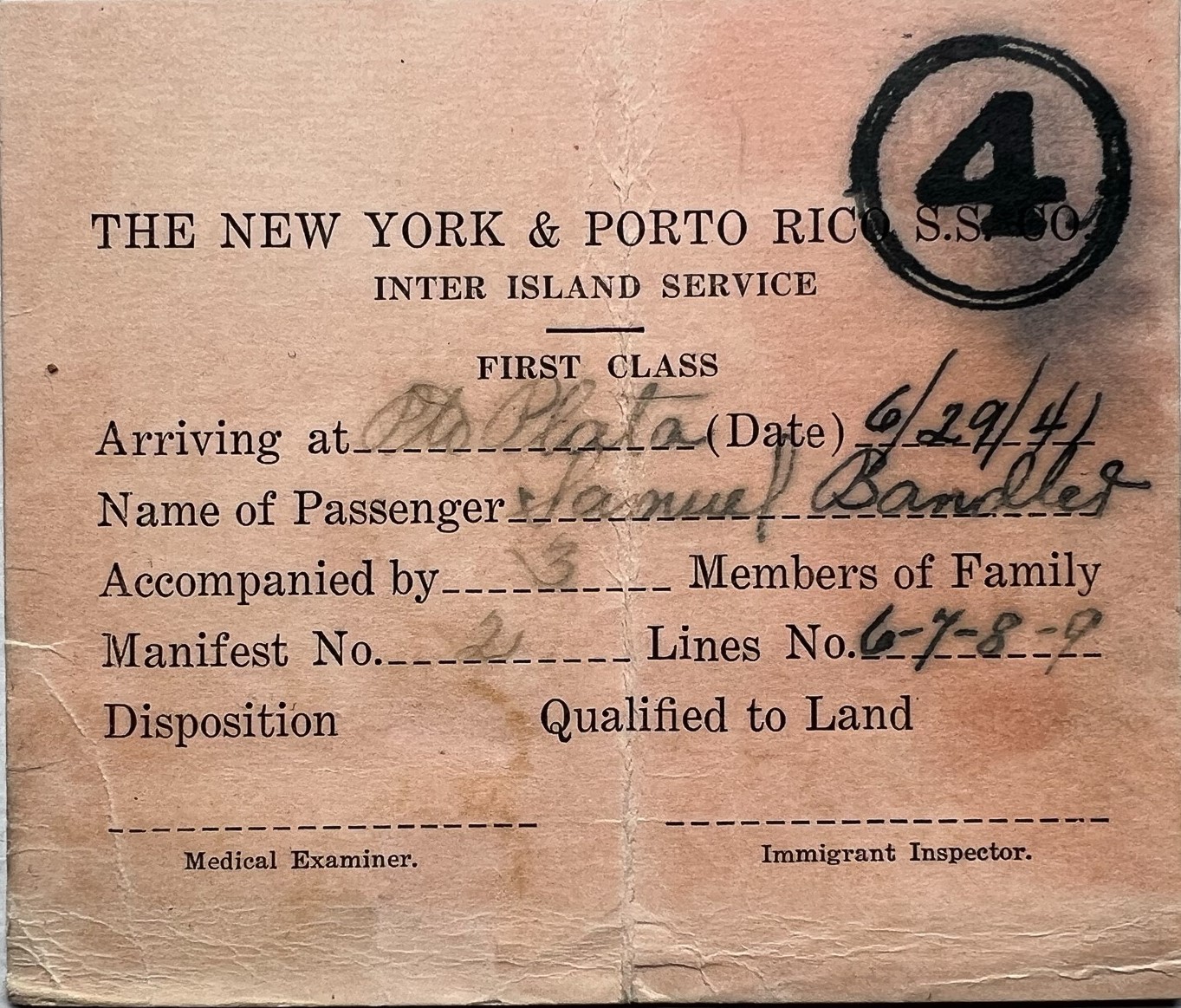
Boarding card for the Bandler family on the New York & Porto Rico line from New York to Puerto Plata, Dominican Republic. June 29, 1941.
Courtesy of Barbara Bandler Steinmetz
Transcript
Barbara: While we were in Ellis Island, my father made contact with relatives. My father had a brother that lived here in the United States, a brother that came here in the mid '30s. And-- and he was a waiter. He had a very hard time earning a living. And frankly, he had very little. My mother also had a relative here. And her-- I think it was either her second or third cousin, some distant relative, obviously somebody that had been in this country for many, many years. And it was just a name she had. And they contacted their relatives. And my Uncle Eugene came to Ellis Island to see us. And the family's name was Gold. They lived in Jamaica-- my mother's family's name was Gold. They lived in Jamaica Plain. And they were-- they owned a cemetery. And they had a funeral business.
And all we knew about them was that they were-- that their name matched their wealth. They were exceedingly wealthy people. My mother did not know them personally. But they came to Ellis Island to visit us. And they brought each of us a doll. I mean, that-- that was the sum total of what I remembered about them until many years later. But they did bring us a doll. Now, you have to know that my sister and I did not bring any toys with us. When we left Italy, we left everything behind. And I don't know how-- how I even felt about that. And I-- you know, I don't remember how I felt about that. And it probably is something that, as a young child, I suppressed. But everything that I owned that was dear to me as a little girl, I had to leave behind. And I probably had things in Hungary too when we went to visit but had to leave that behind. And I'm going to guess that we might have also had some things in Nice. But by the time we got to Ellis Island, we did not have anything at all. And so these dolls became the most important thing in the world to us.
Interviewer: Do you remember the doll's name?
Barbara: No, I don't remember the doll's name. But I do remember what happened to it in the Dominican Republic. Cockroaches! [Laughing] ate-- ate around its eyes. And it didn't bother me at all. I loved that doll. and for-- it seems like I still have the doll somewhere. And I've been trying to find it. And I-- it's probably hidden somewhere in the basement. But I kept the doll all the years, and even with its deformed eyes.
"...everything that I owned that was dear to me as a little girl, I had to leave behind."
USC Shoah Foundation Visual History Archive, Interview 38619
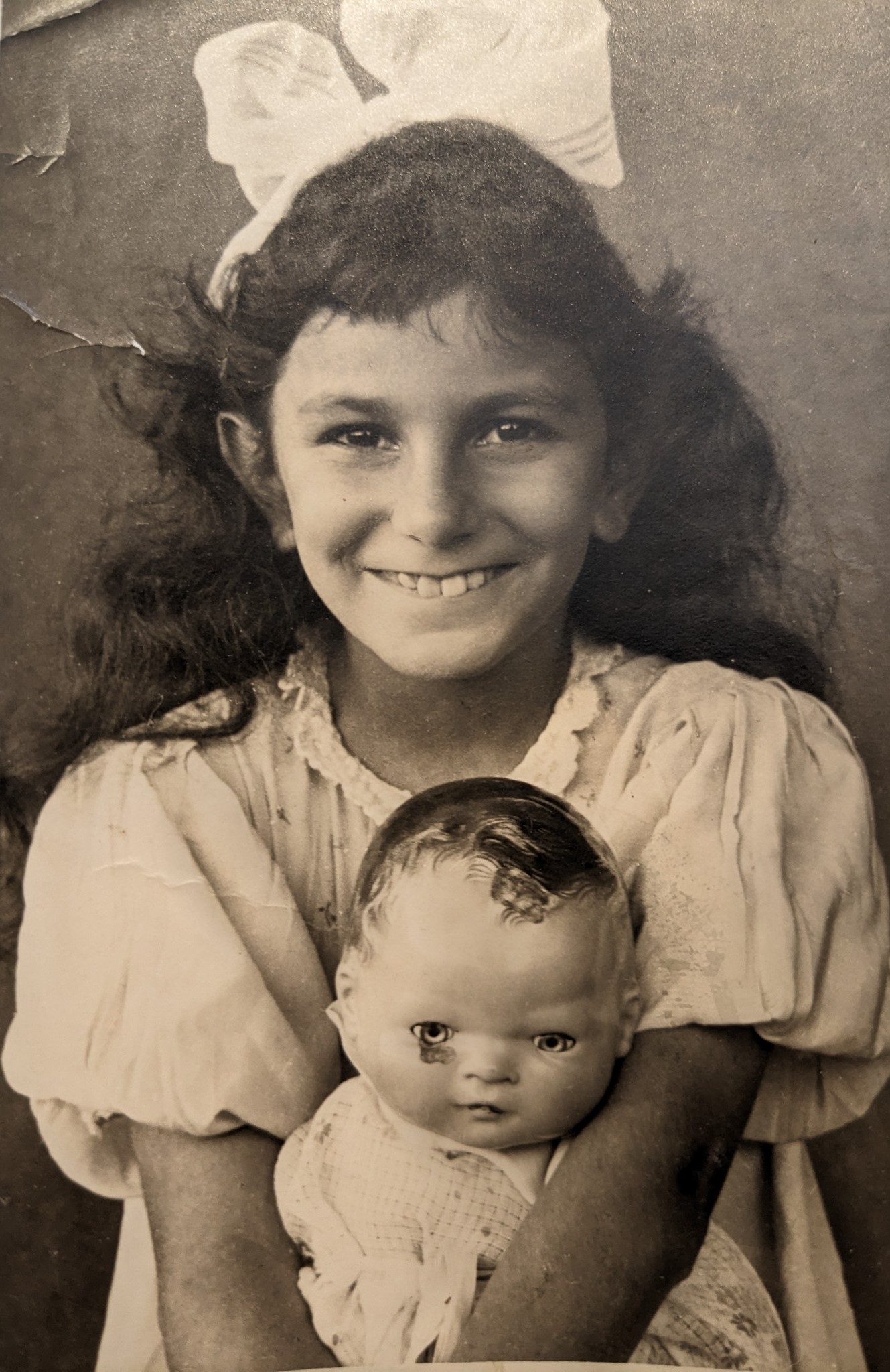
Photo of Barbara with the doll she was given by her mother’s distant cousins, the Gold family, while in Ellis Island in 1941; c. 1944.
Courtesy of Barbara Bandler Steinmetz
Barbara Bandler Steinmetz' Timeline
-
Rome-Berlin Axis Agreement
Italy, under fascist dictator Benito Mussolini, concludes an alliance with Germany's Hitler. Mussolini later issues anti-Jewish legislation and enforces persecution of Italian Jewish community.

-
Barbara Bandler is born in Győr, Hungary
Her parents, Margit and Alexander Bandler, are Hungarian citizens but live in Italy, where Alexander owns a hotel on the Adriatic island of Lussinpiccolo, just off the coast of what is today Croatia. They return to Italy soon after Barbara’s birth
-
Publication of the “Race Manifesto” in Italy
Published anonymously but drawn up by a scholar with close ties to the Fascist government, the article outlines in ten clauses a theoretical framework for the concept of race in Fascist Italy, according to which Italians are essentially Aryan and Jews do not belong to the Italian race.
-
Italy adopts antisemitic laws
Italy adopts a series of antisemitic “Race Laws.” A September 5, 1938 law prohibits Jews from studying or teaching at Italian public schools and universities. A September 7, 1938 law retroactively annuls Italian citizenship granted to Jewish immigrants to Italy after 1919 and revokes permanent residency in Italy for foreign Jews, requiring them to leave the country within six months. Like the Nuremberg Race Laws and other Nazi legislation, additional laws prohibits marriage between Jews and “Aryans,” define who is Jewish, and require all Italian Jews to register, as well as placing restrictions on professional activities and business ownership.
-
Italy and Germany sign the “Pact of Steel”
Expanding on the alliance between the two countries since the Rome-Berlin Axis of October 1936, in the “Pact of Steel” (officially the Pact of Friendship and Alliance) Italy and Germany agree to military cooperation and mutual defense. Despite this agreement, Italy remains neutral during the first year of the war, only entering the war as Germany’s ally in June 1940.
-
Rafael Trujillo and the American Jewish Joint Distribution Committee sign an agreement
The document formalized the first wave of Jewish immigration to a 26,000 acre agricultural settlement in Sosúa, on the northern coast of Hispaniola. The New York City-based American Jewish Joint Distribution Committee set up a separate arm, the Dominican Republic Settlement Association (DORSA), to establish Sosúa as an agricultural community.
-
France formally surrenders to Nazi Germany
Much of France falls to Nazi domination. Parts of southern France are governed by a Nazi collaborator government headed by Marshal Henri Philippe Pétain, called the "Vichy" regime after its capital.
-
Vichy France enacts anti-Jewish legislation
The collaborationist Vichy government enacts a series of anti-Jewish laws in accordance with Nazi policy.
-
Germany orders closure of US diplomatic missions
After the US State Department orders the closure of German consulates in the United States because German diplomats are suspected of spying, Germany and Italy order all American consulates in Axis-occupied Europe to cease operation, closing the door for refugees fleeing Nazi persecution to apply for immigration to the United States.
-
Bandlers set sail for the Dominican Republic
Aboard the Portuguese ship Nyassa, the family sail for the Caribbean, making a stop at Ellis Island on the way.
-
DORSA establishes a hotel in Jarabacoa, Dominican Republic for new Jewish settlers
Disease, fatigue, poor sanitation, the brutal sun, and the emotional distress of dislocation all take their toll on the island’s new Jewish residents. DORSA organizers recognize the need to provide ailing refugees with a place to recuperate from their exertions, and ask Alexander and Margit Bandler to manage the refuge.
-
The Battle of the Caribbean
In an attempt to disrupt the Allied supply of oil and other material by targeting their points of origin in the Caribbean, German and Italian submarines torpedoed 263 ships in the Caribbean, including two Dominican ships. The S. S. Presidente Trujillo and the San Rafael, both named by the Dominican president after himself, were sunk, and 25 crew members were killed.
-
Allies denounce Nazi mass murder of Jews
Reports of the Nazi plan to murder all of the Jewish people in Europe begin to circulate in the second half of 1942 and are widely reported in U.S. newspapers in late November. On December 17 1942, the Allied governments denounce the mass murder of European Jews under Nazi control. Though Nazi crimes are now publicized, Allied forces do not target Nazi killing installations or prioritize the rescue of Jews.
-
Ads for Margit Bandler’s cosmetics company appear in American Jewish newspapers
Lori (Elenor) Mayer, one of Margit’s childhood friends who had immigrated to Boston in the mid-1930s, sees the advertisement in 1945, and sends a letter to Margit in Jarabacoa. Lori and her husband, Eugene, later secure work visas for the Bandlers to enter the U.S.
-
Nazis install new fascist government in Hungary
Nazis arrest Hungarian leader Miklos Horthy and install a new government under Ferenc Szalasi, leader of the fascist and radically antisemitic Arrow Cross Party.
-
Mass executions of Budapest Jews
Between December 1944 and January 1945, approximately 20,000 Jews from Budapest's ghetto are taken to the banks of the Danube, where they are murdered and their bodies thrown into the river.
-
Soviet forces liberate Budapest
After nearly two months, Soviet forces succeed in liberating Budapest from Nazi and Hungarian fascist control. Approximately 100,000 Jews survive, mostly thanks to protections offered by foreign diplomats such as Raoul Wallenberg.
-
Bandler family leaves the Dominican Republic for the U.S.
With little notice, Barbara boards a bus to Santo Domingo, then a plane to Miami, FL, then another bus to Boston, MA where she and her family begin their new American life.
-
Sosúa project dwindles
By the late 1940s, only 275 settlers remain in Sosúa, which had once been home to many hundreds more refugees. DORSA’s experiment under Trujillo never becomes a profitable agricultural settlement, though a successful dairy cooperative founded by Jewish immigrants flourishes there for decades.
-
Hungarian People's Republic established
Soviet forces had remained in Hungary after liberating the country from Nazi occupation in 1944. After the war, Hungary had held democratic elections, but under Soviet influence the Communists successively neutralized all other parties until, in 1949, voters were presented with ballots with only one party list. The newly elected Communist legislature adopted a new, Soviet-style constitution and became a Soviet satellite.
-
Barbara becomes a U.S. citizen
Just a few months before her 16th birthday, Barbara takes the oath to become a United States citizen.
-
Barbara Bandler graduates high school
She and her boyfriend, Howard Steinmetz, make plans to wed, but her father insists she complete her college education before marrying. The two reach an agreement, and Barbara and Howard are married in 1956, after Barbara is accepted to college.
-
Hungarian Revolution of 1956
Student demonstrations in Budapest calling for political and social reforms grow into a broad-based, nationwide popular uprising against the Soviet-backed government of the Hungarian People's Republic. Despite the movement's initial success, the revolution is brutally crushed by Soviet military intervention. Some 200,000 people flee the country in the course of the revolution.
-
Rafael Trujillo assassinated
Trujillo’s reign grows notoriously bloody throughout the 1950s, though his repression is not felt in Sosúa. Still, political unrest, economic woes, and scandal plague the General’s rule. In May 1961, the embattled dictator is assassinated by a group of conspirators who ambushed his turquoise Chevrolet Bel Air. Trujillo’s death sets off a period of political instability in the Dominican Republic that drives many of the few remaining Jewish residents to emigrate.
-
Barbara and Howard move to Boulder, CO
After vacationing in Colorado for decades, the pair finally decide to settle permanently.