
Life as an American teenager

Barbara Bandler Steinmetz
Barbara is one step closer to being an all-American teenager in September 1951, when she becomes a U.S. citizen and starts high school. She goes on to become a cheerleader and captain of her high school’s swim team, emerging as a popular, busy, and high-achieving teen. While at home, Barbara struggles to understand her demanding parents. All teenagers experience family conflicts, but Barbara’s process of Americanization increases those tensions. She recalls: “I told my dad when I was a teenager I was unhappy, and my dad said, ‘You’re unhappy? You have a roof over your head and food on the table, you have no right to be unhappy!’”
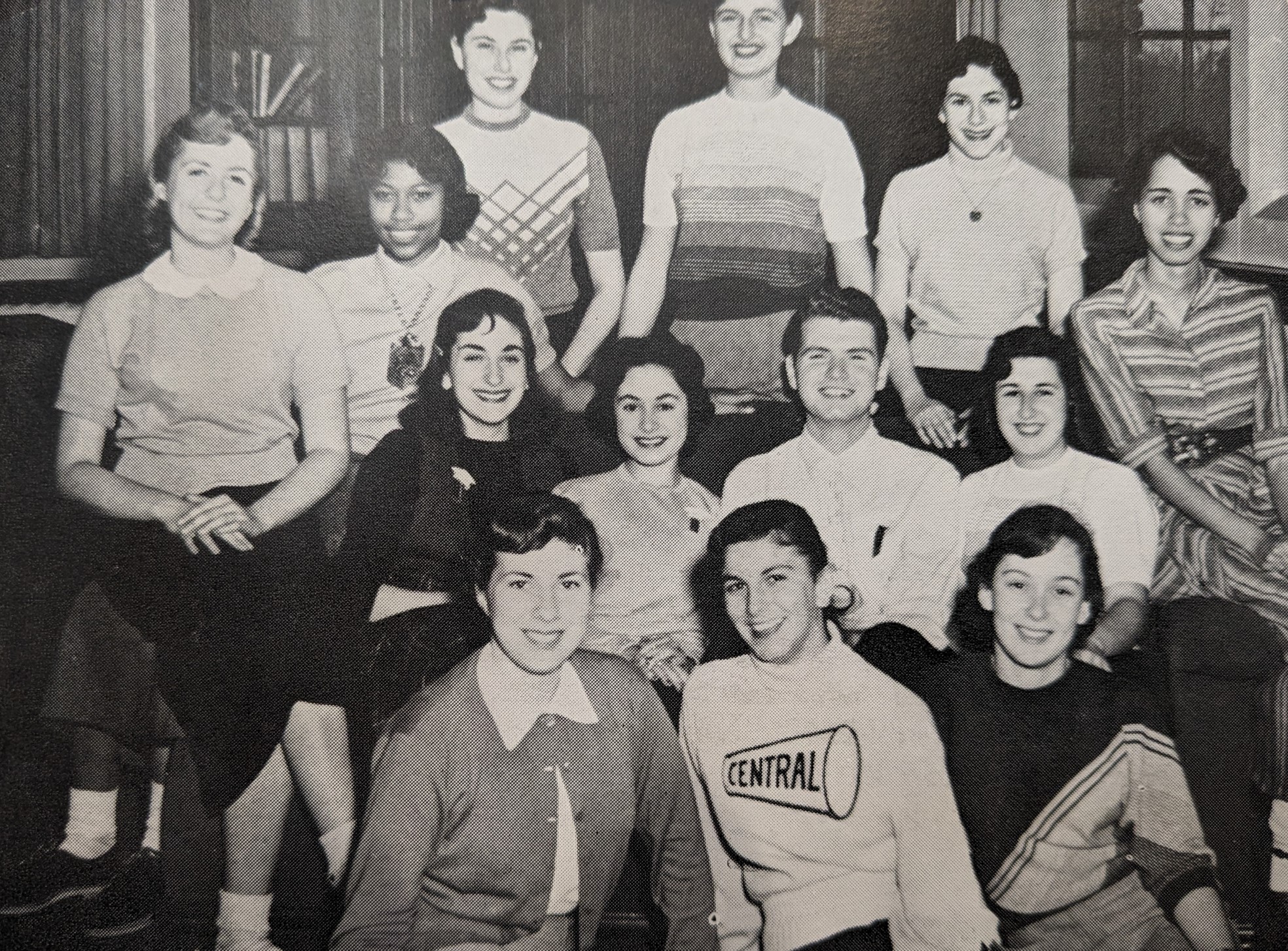
A photo from Barbara’s high school yearbook, c. 1953. Barbara is in front, wearing a Central High cheerleading sweater.
Courtesy of Barbara Bandler Steinmetz
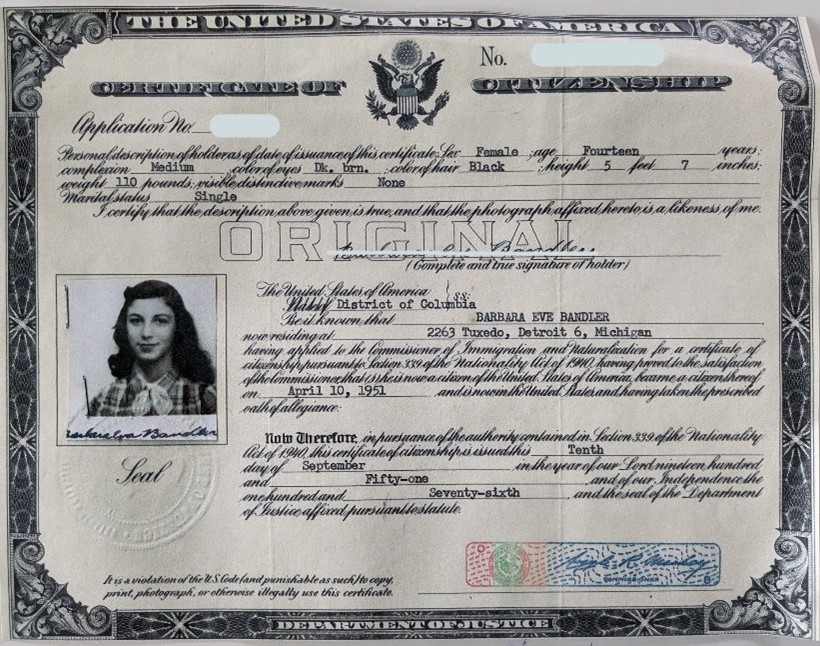
Barbara became a U.S. citizen on September 10, 1951.
Courtesy of Barbara Bandler Steinmetz
Transcript
Barbara: So in-- in New York, my father was able to get a-- a position in Detroit. So again, that summer in New York I went to summer camp. My mother went to work. My cousin went to work. And -- and we ended up in September in yet another city, and a new school, and new people. And again, we all lived in a very small, furnished apartment in-- in Detroit. And I started school in Detroit. And my mother went to work for the Jewish Community Center as a cook. And the reason that I want to mention that is because the Jews in the Jewish Center didn't believe she was Jewish. And I remember my mother coming home, and she was in total disbelief. She said she didn't understand these American Jews. [LAUGHS] What did they think? My mother didn't speak Yiddish. My parents were--in-- in Hungary, not all people spoke Yiddish as the Russian and Polish Jews. They all spoke Yiddish. But Hungarian Jews did not. So my mother didn't know Yiddish. And the Jews that she had contact with in Detroit all spoke Yiddish, and they-- they didn't-- they never knew of a Jew that didn't speak Yiddish. So they didn't-- [LAUGHS] they didn't believe that she was Jewish. They also didn't want to hear about her experiences. And-- and they called her a greenhorn. The other Jewish people called her a greenhorn.
And as a matter of fact, that's-- that's really been my mom's experience in this country-- was that she was made very much aware that she was a greenhorn, and somehow or other, not as good as anyone else. And frankly, she was more educated than most of [LAUGHS] them.
"The other Jewish people called her a greenhorn."
USC Shoah Foundation Visual History Archive, Interview 38619
Like most teens, Barbara can’t imagine her parents’ emotional world: “I never considered that they had this beautiful life, and then they had to go on the run to save their lives.” She knows her family is different from the families of her friends. Her parents speak English with thick accents. Their used furniture is mismatched. They dress differently. Margit works long hours at a time when married women are expected to be homemakers. “My mother would get up at 4, cut a grapefruit for us so when we got up, we’d have something ready for us on the table,” Barbara remembers, “and by 5 she was gone, waiting at the bus stop in the freezing cold to go to work. But she never complained.”
Her father had more difficulty accepting his diminished status. At times, Alexander became domineering in his efforts to control his daughters. Alexander forbid Barbara from cutting her long hair, even though short hair was then in style. When she was 15, a boy asked her to come to a party with him, and she accepted. As Barbara was getting ready, she saw her father getting dressed and putting on a tie. “I asked him, ‘Are you going somewhere?’ and he said, ‘Yes, I’m going out with you. What kind of father would I be if I let you out with a boy alone?’” Today Barbara laughs at the memory, but at the time she had to beg her mother to convince her father to let her go to the party alone. Alexander would sometimes ask his daughters at the end of a school day, “What have you done to justify your existence?” Barbara’s father sought to provide some meaning to what he and Margit had endured, she explains, “and my sister and I were his justifications for surviving, for being lucky.”
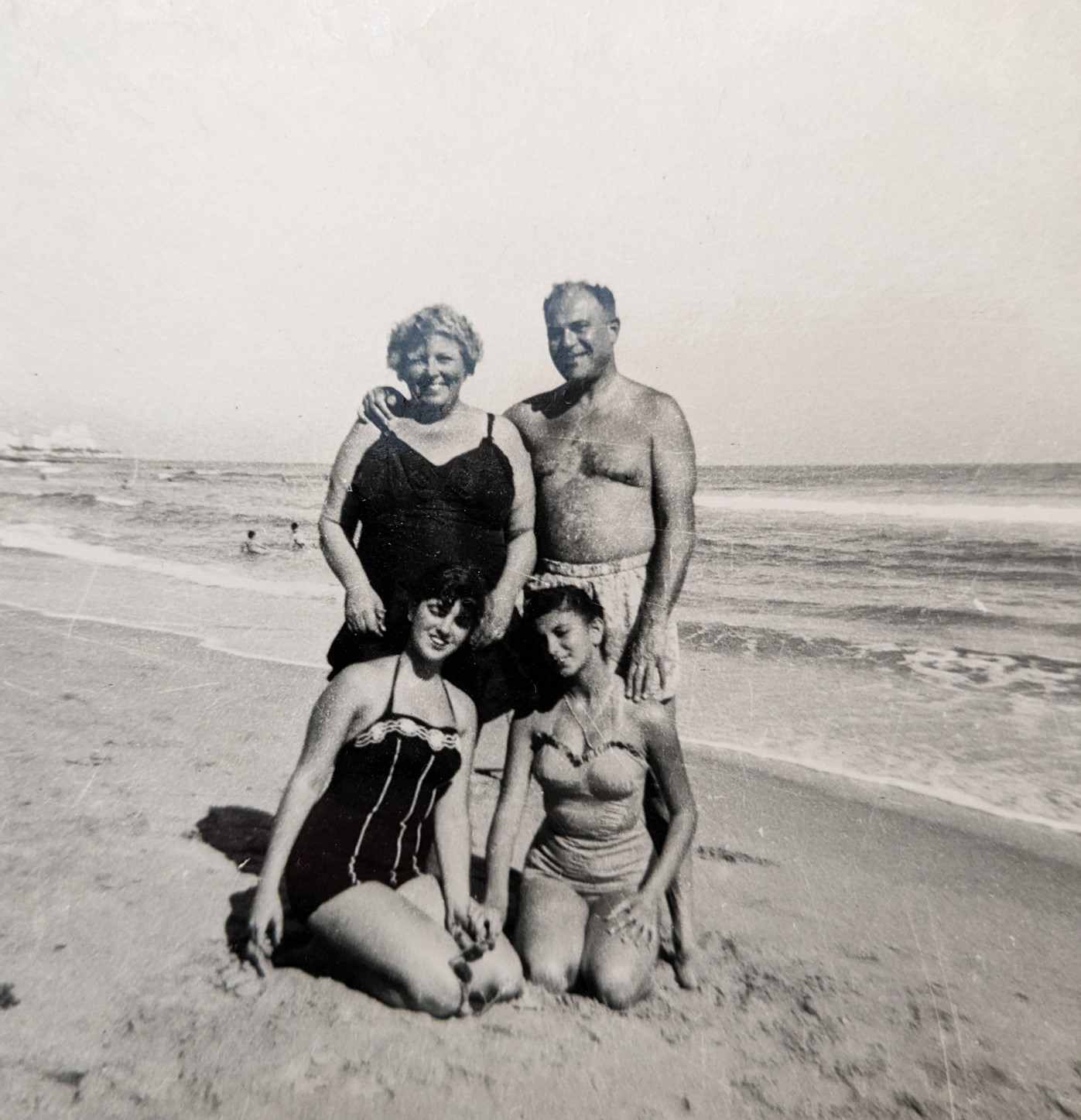
The Bandler family at the beach on vacation in Florida, c. 1954.
Courtesy of Barbara Bandler Steinmetz
Transcript
Barbara: She [Barbara's mother] and my cousin [Panni] worked at the Jewish Center, and my father worked as a cook. And eventually, after having been kicked out of so many jobs from Boston to New York and then went to cook in Detroit, he-- he is an incredible man. He was an incredible man. He truly became a great chef. And he had jobs in Detroit at the most prestigious country clubs. He was the head chef in those country clubs.
And it-- it is an amazing thing that this guy, who really went from place to place, and somehow or other had enough gumption to learn something and learn it well, and be the best. In the middle of it all, he gave it up. He was in his-- well, in 1945 when we came to this country he was 43 years old. So in 19-- by 1950, he decided he no longer wanted to be a chef. Because again, because of the family-- and the family life is very important to my parents. My dad felt that as a chef, he was working all the holidays, all the weekends. And again, he didn't schlep his family all over the world for him not to spend any time with us. His daughters were growing up, and he wanted to spend more time with us.
So the reason I'm putting this in here is just to share with you this man's incredible determination. He put an ad--he-- he read an ad in the newspaper for salesmen in the advertising specialty industry. He didn't know a thing about the advertising specialty industry. But he answered the ad. And it was someone in New York that was hiring. And--and he-- he said he wanted to do this. They sent him a bunch of samples, and he was to go calling on customers. Now, he had no background as to what to do, how to do it, how to go out. But he read through the materials. And by golly, that guy went out, and he was a salesman. He started selling specialty advertising, and he ended up doing pretty well. But it gave him some free time. It gave him his weekends off, his vacations off. And he-- he would call customers, and he would say-- say who it is on the phone. And they'd say, well, I-- I recognize you by your accent. And my-- my father would say, what accent? I don't have an accent. And he was-- he was the most determined person in the world. He was just incredible.
And my mother went to work for Burroughs Adding Machine, in the kitchen. She always continued working in the kitchen. And then she became very heart diseased and got diabetes. And unfortunately, they both died very young. My mother-- my father was 62. My mother was 66. And so they-- they really never made it to the years where they would have gotten some pleasures out of life. But they left quite a legacy with their kids.
"... my father would say, 'What accent? I don't have an accent!' And he was the most determined person in the world."
USC Shoah Foundation Visual History Archive, Interview 38619
The pressures and anxieties of immigration mean that her parents often fight with one another, too. “Kids of immigrant parents just don’t understand how hard it is,” Barbara says. Alexander works every weekend, every holiday, and as Barbara advances through high school, he decides to shift careers. He applies for a job as an advertising specialty salesman, even though he has no idea what the position means; he soon finds out that he will be selling t-shirts, pens, pencils, and calendars branded with a corporate logo. Companies give away the branded items as gifts or incentives to clients and employees. Alexander thrives as a salesman due to his natural charisma, and despite his heavy accent and total lack of experience.
Barbara and Howard, her older crush, begin dating seriously while she is still in high school and he is at the University of Michigan in Ann Arbor. Alexander likes Howard, but his behavior towards his daughter’s boyfriend can be unpredictable. One day, Howard returns from college to visit Barbara while Alexander sits nearby reading the paper. Howard mentions that he no longer believes in God or in being Jewish. At that, Alexander jumps up, flying into a rage, takes Howard by the collar, and throws him out of the house. “My father had gone through all he had gone through because he was Jewish,” Barbara considers, “and here was Howard trying to deny [his identity], and my father just lost it.” Although the Bandlers are not religiously observant, the family always retained a profound respect for their Jewish heritage, and mourned the Jewish world that was destroyed in the Holocaust. For Barbara, the time she spent in Jewish summer camps helped her form an identity and a sense of Jewish community that has never left her.
Barbara graduates high school in 1954 and she and Howard make plans to marry. When the sweethearts announce their intentions to the Bandlers, Alexander responds, “Oh! My deepest congratulations to you.” He pauses dramatically. “Of course,” he says, turning to Barbara and lowering his voice, “your mother and I won’t be there. We couldn’t possibly attend a wedding we had not approved of.” Alexander’s objections are in part because he wants Barbara to go to college. Alexander had not had the benefit of a formal education, but he remains a life-long learner who hungrily borrows books in multiple languages from the local library.
Alexander often reminds his daughters how fortunate they are to be in America and have the opportunity to go to school. Once, he berates Barbara’s friend’s parents for not encouraging their daughter to apply to college. He storms over to their house and thunders: “How dare you not send your daughter to college!” Barbara applies and is accepted to the University of Michigan in Ann Arbor. (So is her friend.) After one year in Ann Arbor, Barbara transfers to the less-expensive and closer-to-home Wayne State University in Detroit, where she studies for three years.
Barbara Bandler Steinmetz' Timeline
-
Rome-Berlin Axis Agreement
Italy, under fascist dictator Benito Mussolini, concludes an alliance with Germany's Hitler. Mussolini later issues anti-Jewish legislation and enforces persecution of Italian Jewish community.

-
Barbara Bandler is born in Győr, Hungary
Her parents, Margit and Alexander Bandler, are Hungarian citizens but live in Italy, where Alexander owns a hotel on the Adriatic island of Lussinpiccolo, just off the coast of what is today Croatia. They return to Italy soon after Barbara’s birth
-
Publication of the “Race Manifesto” in Italy
Published anonymously but drawn up by a scholar with close ties to the Fascist government, the article outlines in ten clauses a theoretical framework for the concept of race in Fascist Italy, according to which Italians are essentially Aryan and Jews do not belong to the Italian race.
-
Italy adopts antisemitic laws
Italy adopts a series of antisemitic “Race Laws.” A September 5, 1938 law prohibits Jews from studying or teaching at Italian public schools and universities. A September 7, 1938 law retroactively annuls Italian citizenship granted to Jewish immigrants to Italy after 1919 and revokes permanent residency in Italy for foreign Jews, requiring them to leave the country within six months. Like the Nuremberg Race Laws and other Nazi legislation, additional laws prohibits marriage between Jews and “Aryans,” define who is Jewish, and require all Italian Jews to register, as well as placing restrictions on professional activities and business ownership.
-
Italy and Germany sign the “Pact of Steel”
Expanding on the alliance between the two countries since the Rome-Berlin Axis of October 1936, in the “Pact of Steel” (officially the Pact of Friendship and Alliance) Italy and Germany agree to military cooperation and mutual defense. Despite this agreement, Italy remains neutral during the first year of the war, only entering the war as Germany’s ally in June 1940.
-
Rafael Trujillo and the American Jewish Joint Distribution Committee sign an agreement
The document formalized the first wave of Jewish immigration to a 26,000 acre agricultural settlement in Sosúa, on the northern coast of Hispaniola. The New York City-based American Jewish Joint Distribution Committee set up a separate arm, the Dominican Republic Settlement Association (DORSA), to establish Sosúa as an agricultural community.
-
France formally surrenders to Nazi Germany
Much of France falls to Nazi domination. Parts of southern France are governed by a Nazi collaborator government headed by Marshal Henri Philippe Pétain, called the "Vichy" regime after its capital.
-
Vichy France enacts anti-Jewish legislation
The collaborationist Vichy government enacts a series of anti-Jewish laws in accordance with Nazi policy.
-
Germany orders closure of US diplomatic missions
After the US State Department orders the closure of German consulates in the United States because German diplomats are suspected of spying, Germany and Italy order all American consulates in Axis-occupied Europe to cease operation, closing the door for refugees fleeing Nazi persecution to apply for immigration to the United States.
-
Bandlers set sail for the Dominican Republic
Aboard the Portuguese ship Nyassa, the family sail for the Caribbean, making a stop at Ellis Island on the way.
-
DORSA establishes a hotel in Jarabacoa, Dominican Republic for new Jewish settlers
Disease, fatigue, poor sanitation, the brutal sun, and the emotional distress of dislocation all take their toll on the island’s new Jewish residents. DORSA organizers recognize the need to provide ailing refugees with a place to recuperate from their exertions, and ask Alexander and Margit Bandler to manage the refuge.
-
The Battle of the Caribbean
In an attempt to disrupt the Allied supply of oil and other material by targeting their points of origin in the Caribbean, German and Italian submarines torpedoed 263 ships in the Caribbean, including two Dominican ships. The S. S. Presidente Trujillo and the San Rafael, both named by the Dominican president after himself, were sunk, and 25 crew members were killed.
-
Allies denounce Nazi mass murder of Jews
Reports of the Nazi plan to murder all of the Jewish people in Europe begin to circulate in the second half of 1942 and are widely reported in U.S. newspapers in late November. On December 17 1942, the Allied governments denounce the mass murder of European Jews under Nazi control. Though Nazi crimes are now publicized, Allied forces do not target Nazi killing installations or prioritize the rescue of Jews.
-
Ads for Margit Bandler’s cosmetics company appear in American Jewish newspapers
Lori (Elenor) Mayer, one of Margit’s childhood friends who had immigrated to Boston in the mid-1930s, sees the advertisement in 1945, and sends a letter to Margit in Jarabacoa. Lori and her husband, Eugene, later secure work visas for the Bandlers to enter the U.S.
-
Nazis install new fascist government in Hungary
Nazis arrest Hungarian leader Miklos Horthy and install a new government under Ferenc Szalasi, leader of the fascist and radically antisemitic Arrow Cross Party.
-
Mass executions of Budapest Jews
Between December 1944 and January 1945, approximately 20,000 Jews from Budapest's ghetto are taken to the banks of the Danube, where they are murdered and their bodies thrown into the river.
-
Soviet forces liberate Budapest
After nearly two months, Soviet forces succeed in liberating Budapest from Nazi and Hungarian fascist control. Approximately 100,000 Jews survive, mostly thanks to protections offered by foreign diplomats such as Raoul Wallenberg.
-
Bandler family leaves the Dominican Republic for the U.S.
With little notice, Barbara boards a bus to Santo Domingo, then a plane to Miami, FL, then another bus to Boston, MA where she and her family begin their new American life.
-
Sosúa project dwindles
By the late 1940s, only 275 settlers remain in Sosúa, which had once been home to many hundreds more refugees. DORSA’s experiment under Trujillo never becomes a profitable agricultural settlement, though a successful dairy cooperative founded by Jewish immigrants flourishes there for decades.
-
Hungarian People's Republic established
Soviet forces had remained in Hungary after liberating the country from Nazi occupation in 1944. After the war, Hungary had held democratic elections, but under Soviet influence the Communists successively neutralized all other parties until, in 1949, voters were presented with ballots with only one party list. The newly elected Communist legislature adopted a new, Soviet-style constitution and became a Soviet satellite.
-
Barbara becomes a U.S. citizen
Just a few months before her 16th birthday, Barbara takes the oath to become a United States citizen.
-
Barbara Bandler graduates high school
She and her boyfriend, Howard Steinmetz, make plans to wed, but her father insists she complete her college education before marrying. The two reach an agreement, and Barbara and Howard are married in 1956, after Barbara is accepted to college.
-
Hungarian Revolution of 1956
Student demonstrations in Budapest calling for political and social reforms grow into a broad-based, nationwide popular uprising against the Soviet-backed government of the Hungarian People's Republic. Despite the movement's initial success, the revolution is brutally crushed by Soviet military intervention. Some 200,000 people flee the country in the course of the revolution.
-
Rafael Trujillo assassinated
Trujillo’s reign grows notoriously bloody throughout the 1950s, though his repression is not felt in Sosúa. Still, political unrest, economic woes, and scandal plague the General’s rule. In May 1961, the embattled dictator is assassinated by a group of conspirators who ambushed his turquoise Chevrolet Bel Air. Trujillo’s death sets off a period of political instability in the Dominican Republic that drives many of the few remaining Jewish residents to emigrate.
-
Barbara and Howard move to Boulder, CO
After vacationing in Colorado for decades, the pair finally decide to settle permanently.