
Hotel Alhambra

Barbara Bandler Steinmetz
Barbara and Ann spend their early years amidst the bustle of the hotel. Alexander and Margit work tirelessly to ensure their guests’ comfort. Word spreads of the hospitality on offer, and the Bandler family’s Hotel Alhambra prospers as post-World War I travelers flock to the turquoise waters of Čikat Bay and the tranquil groves of pine trees edging the coast. Barbara recalls swimming in the clear waters and being coddled by hotel guests.
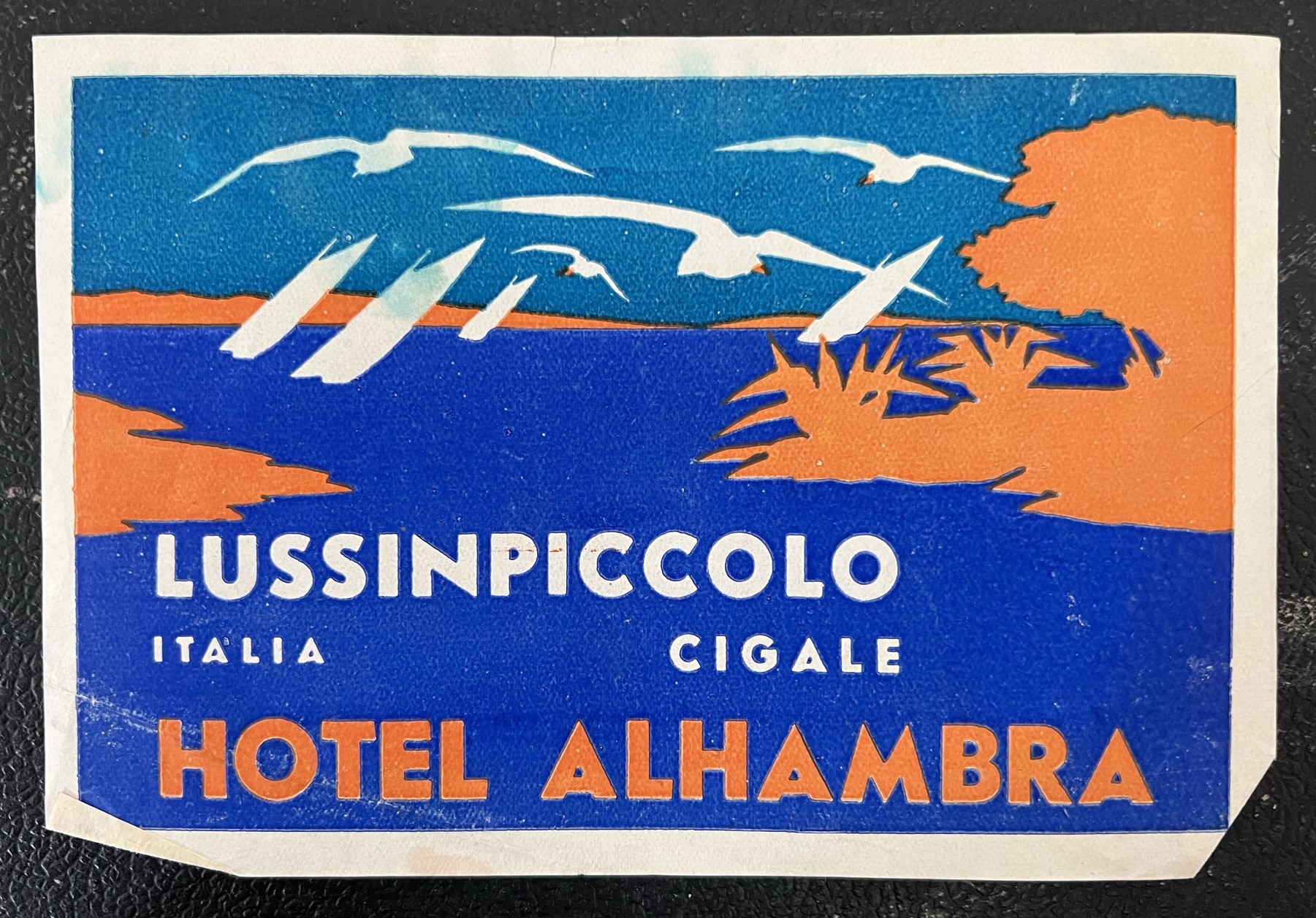
Luggage sticker for the Hotel Alhambra in Lussinpiccolo, 1930s.
Courtesy of Barbara Steinmetz
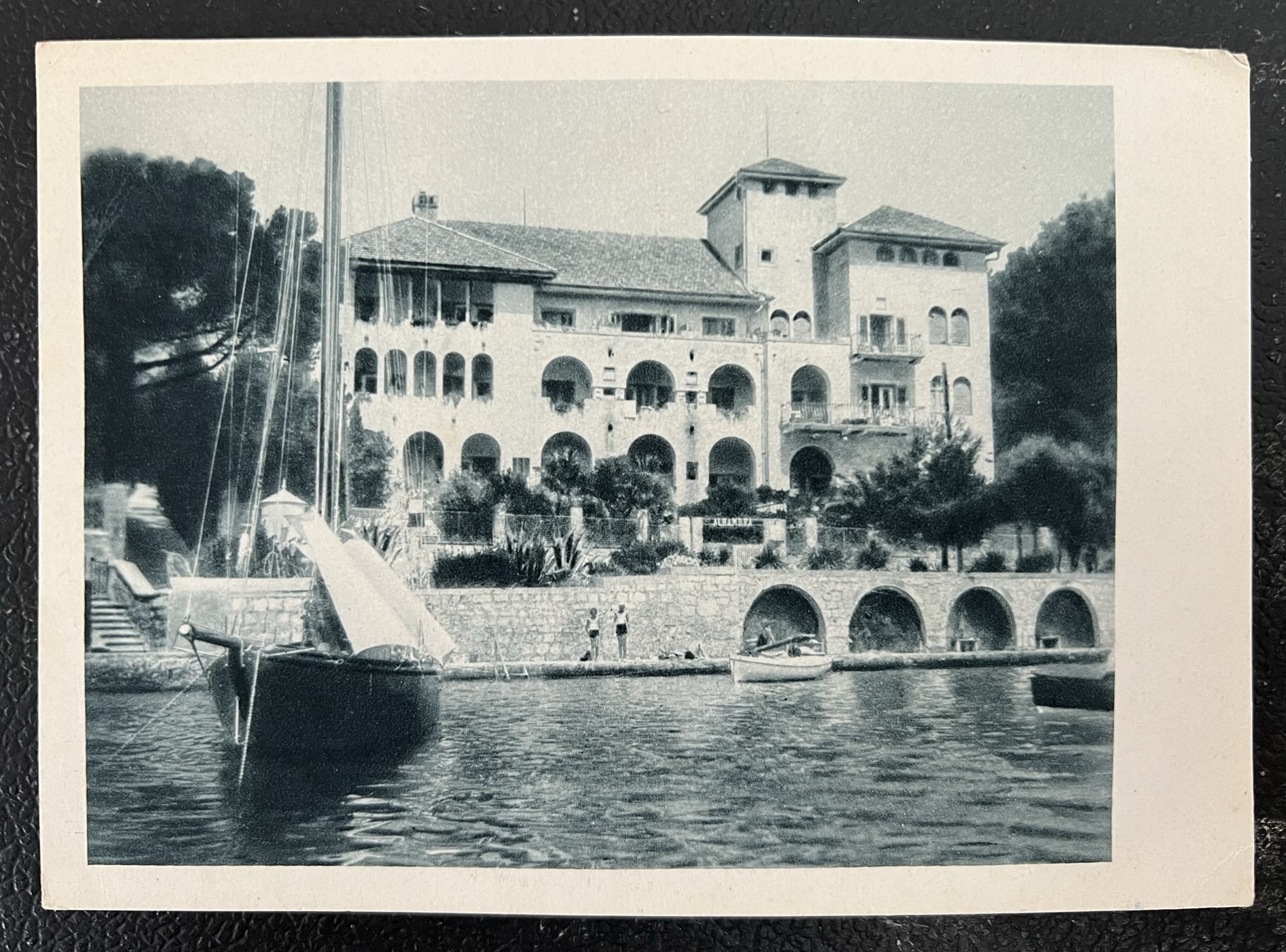
Postcard of the Hotel Alhambra in Lussinpiccolo, 1930s.
Courtesy of Barbara Steinmetz
The whole Bandler family is engaged in making hotel guests feel welcome. When guests arrive on the island, they are met at the dock by Alexander, Margit, and their two young daughters, and made to feel as if they are guests of the Bandler family. The small photo album pictured here, a gift from guests in the summer of 1938 who documented their holiday at the Alhambra with the Bandlers in photos, offers proof of the extraordinary hospitality provided to guests of the hotel, many of whom returned year after year.
Transcript
Barbara: My parents had this very large hotel, and they had clients, people that came to the resort. It is a resort island on the Adriatic, and people came from all over, mostly Germany, England, probably some from France. And so there was constantly activity in our lives when we were little children. And the hotel guests played with us and talked to us when we were little children. My parents, of course, were very busy with their hotel, and so my sister and I had a nanny, a wonderful lady from Austria. Her name was "Tetsi." And she eventually moved with us from place to place and married a Jewish man, but she was-- she was really the person that we were with. But life in a hotel for a child is really quite a wonderful place, because there are not only the guests in the hotel, but all the service people that worked at the hotel. You know, the children of the owners have a very-- have a very special place. And so we were treated that way. But I left Italy when I was very young, so that kind of life I really experienced for just a very short while.
Interviewer: Are there some special memories about your parents that you'd like to share while you were in Italy?
Barbara: I don't really have a clear memory of what my parents were like. I'm going to-- only from stories that I hear, and of course, because my sister was that much older than me, and so I-- she has told me so much about what they were like. But my father and mother were both very sophisticated Europeans. They knew fine wines, certainly fine foods, and were just very, very worldly, very knowledgeable. My dad was a wonderful hotel host, and the guests came back year after year. And so they really became friends with many of the guests. It was-- as I say, it was a wonderful resort, right on the Adriatic. The town was charming-- the small Italian village. And my parents were, were just these hotel hosts and did the kinds of things that hotel hosts do. I don't remember anything more specific about my relationship with them. I'm-- I was less than three years old when I left there. So those memories I don't have.
"...life in a hotel for a child is really quite a wonderful place, because there are not only the guests in the hotel, but all the service people that worked at the hotel. You know, the children of the owners have a very-- have a very special place."
USC Shoah Foundation Visual History Archive, Interview 38619
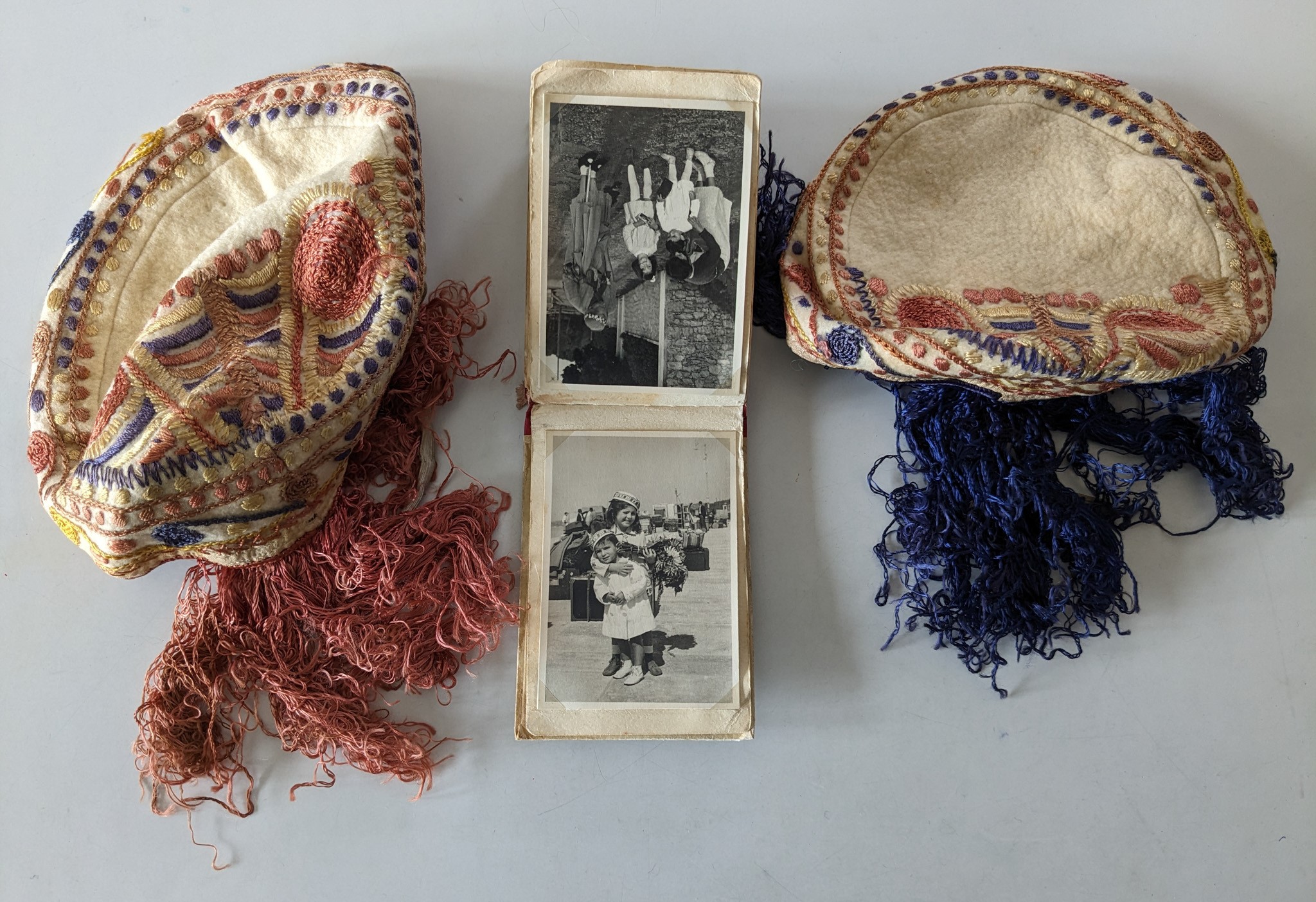
Hats with typical Hungarian embroidery, worn by Ann and Barbara Bandler in the photo in the center. The photo was taken as the girls greet hotel guests arriving at the dock in Lussinpiccolo. The small photo album pictured was made for the Bandlers by hotel guests and contains photographs of the hotel and the Bandler family during the summer of 1938.
Courtesy of Barbara Bandler Steinmetz
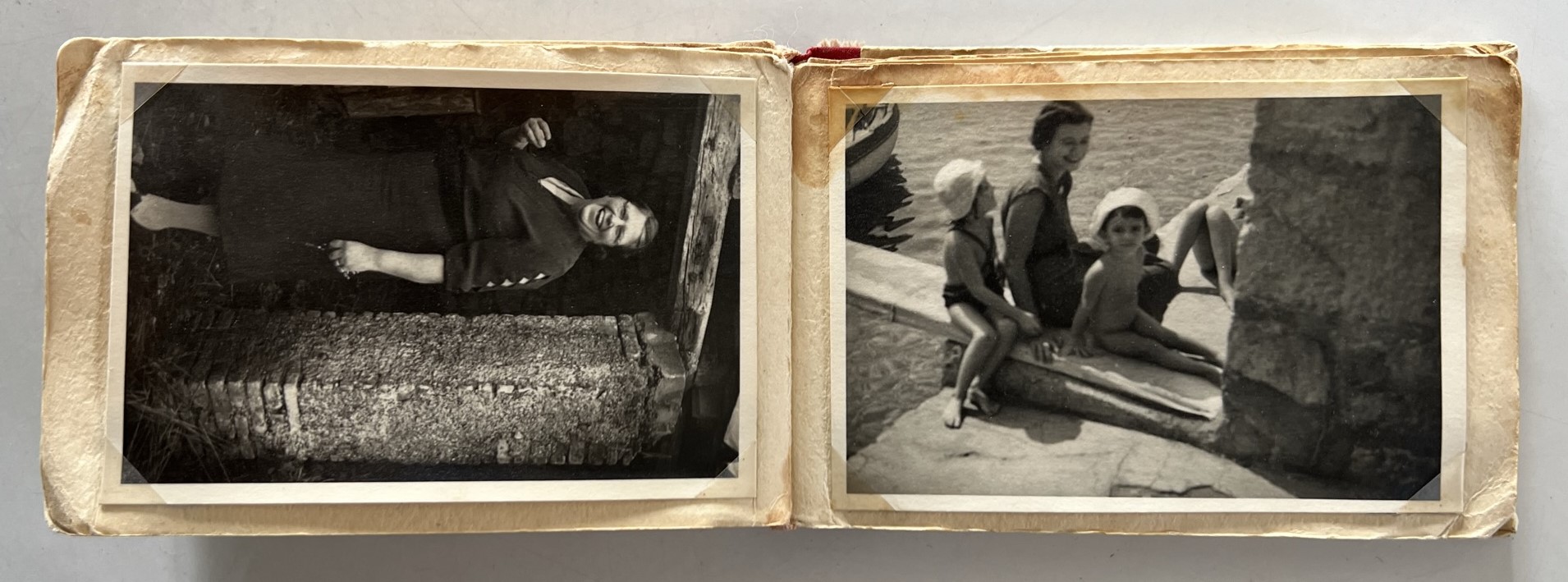
Small photo album that was given to the Bandlers by guests in summer 1938, with photos of (l): Margit Bandler, Barbara’s mother; and (r): Barbara (r) and Ann (l) with their Austrian nanny, "Tetsi." Lussinpiccolo, 1938.
Courtesy of Barbara Bandler Steinmetz
For much of the 1930s, Jews can live unmolested in Italian territory, despite the specter of dictator Benito Mussolini’s fascist regime. But as war casts its shadows over Europe, and as Mussolini formalizes his alliance with Hitler’s Germany, Jewish citizens and residents of Italy face open persecution. Mussolini’s rhetoric and policies intensify in 1938, culminating in the series of antisemitic legislation known as the Race Laws, enacted in the fall of that year. Among the earliest provisions of these laws is the forced deportation of foreign Jews living in Italy, and the expropriation/forfeiture of their business assets.
Because the Bandlers are not Italian citizens, they face expulsion from Italy and will be forced to abandon their successful hotel and leave their home in Lussinpiccolo. But in 1938, there are few doors open to Jewish refugees: virtually every country has restrictive immigration quotas barring refugees from entry. When immigration officials representing 32 countries—including the United States—convene in France in the summer of 1938 for the Evian Conference, they have nothing more than sympathy to offer for the situation of European Jews. Only the tiny Caribbean nation of the Dominican Republic agrees to accept more refugees.
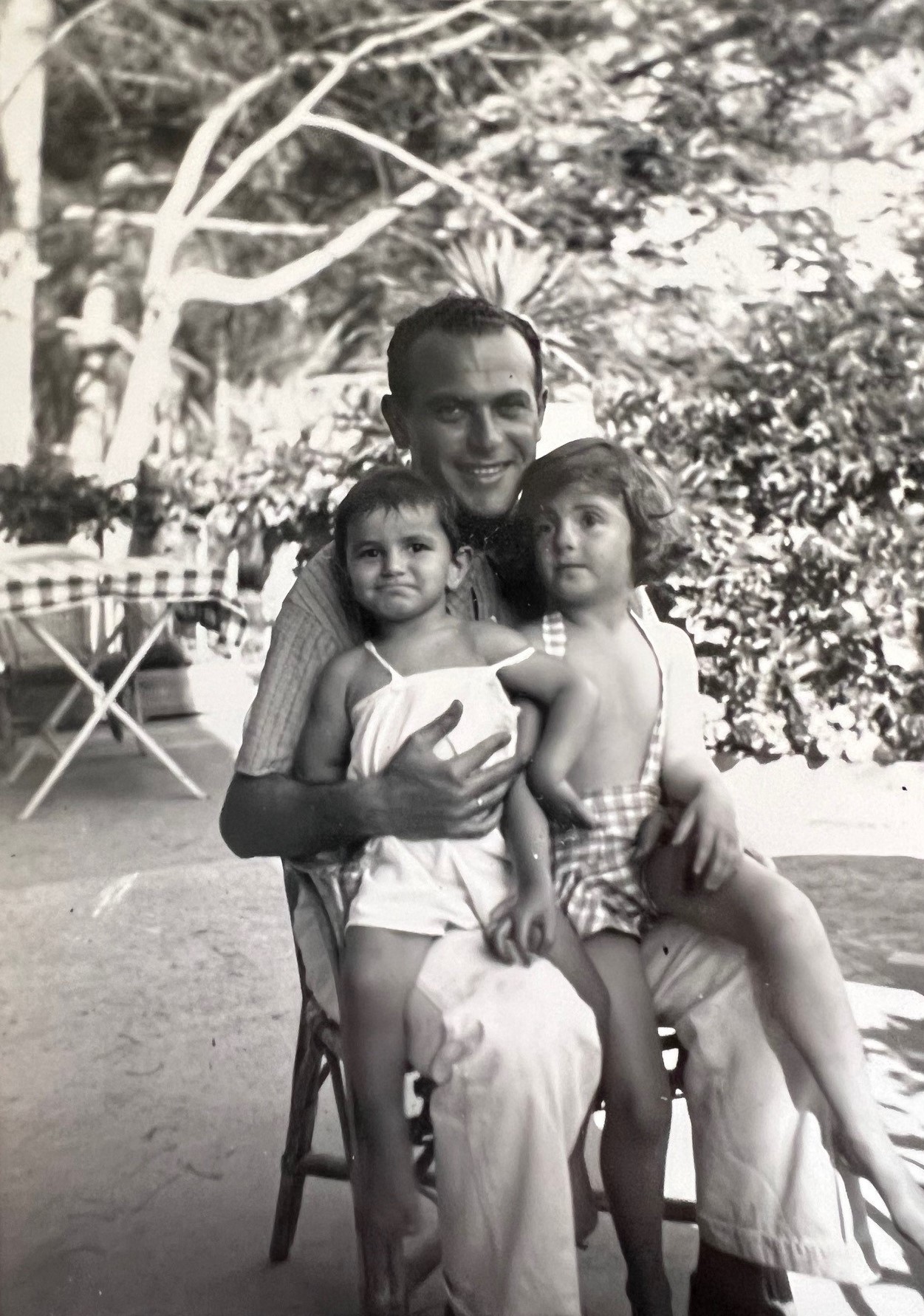
Photo of Alexander Bandler with Barbara (l) and Ann (r) in Lussinpiccolo, c. 1938.
Courtesy of Barbara Bandler Steinmetz
Barbara’s father understands the gravity of the situation and is determined to get his family out of Europe. Immediately after Italy’s Race Laws are announced in September 1938, he begins writing letters to influential guests of his hotel to ask for assistance in obtaining visas for himself and his family to leave Europe. He writes to clients, friends, and authorities in England, South Africa, Iceland, New Zealand, and Venezuela, among others, but his efforts are to no avail.
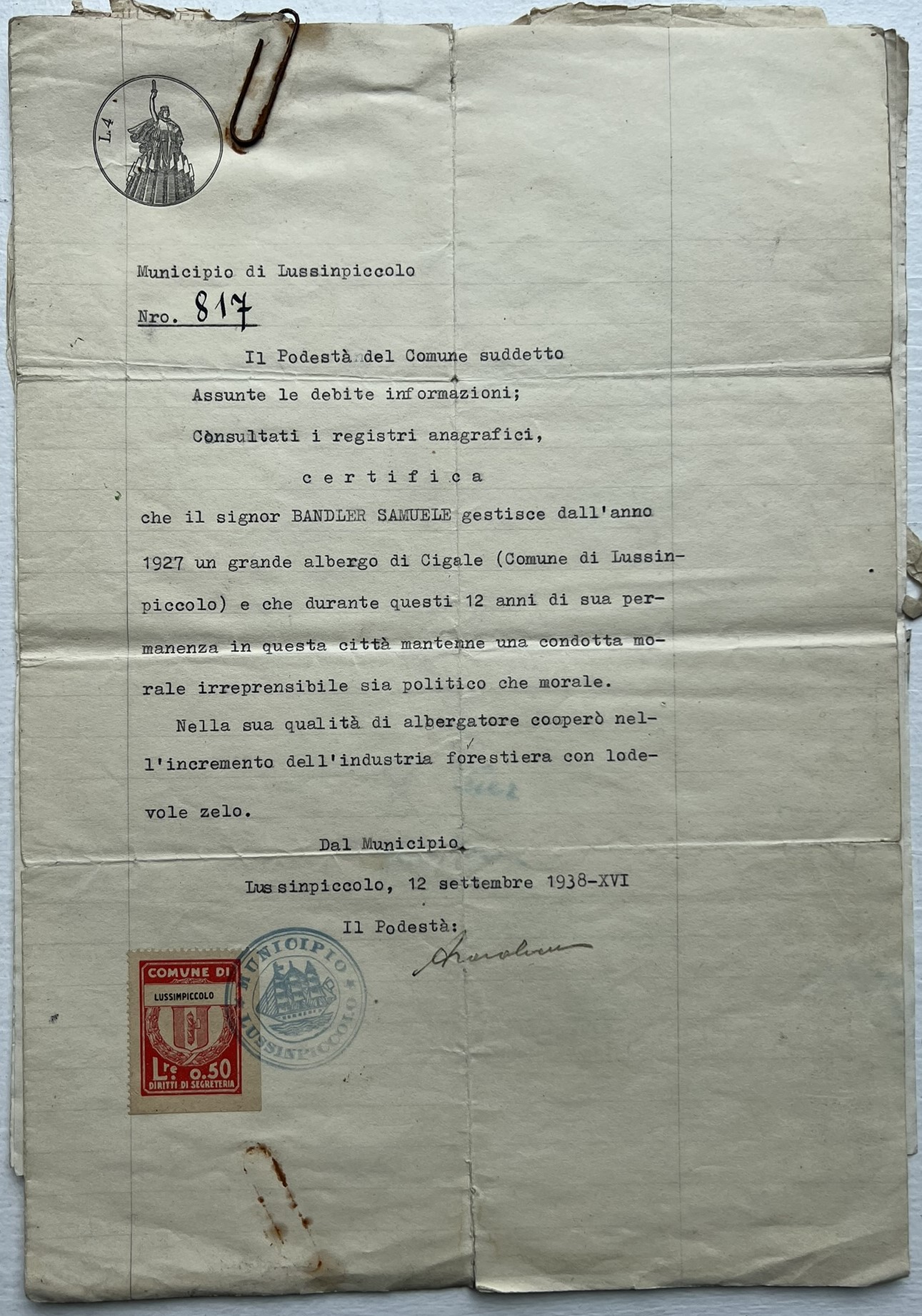
Letter of good conduct issued to Alexander Bandler by the municipality of Lussinpiccolo, September 12, 1938.
Courtesy of Barbara Bandler Steinmetz
Transcript
Barbara: My father was a man who was extremely excited by challenges in life. And so in some respects, what happened to him met the kind of personality he was, that he was totally challenged by, by all the hurdles that he had to overcome. I'm sure that the only thing that he had in mind was to keep us alive. In that respect, he chose guests who were living in-- who had come to our hotel and asked them for help in getting out of Italy, getting out of Europe-- well, not necessarily out of Europe, but certainly getting out of Italy at the time.
And with that, he wrote or he asked for a letter of good conduct, which was sent to embassies around. And I'd like to read the letter of good conduct right now that came in 1938. This was one of the ones that was sent to the British consulate. And it's from the mayor of the municipality of Lussinpiccolo. And it says that Mr. Alex-- Mr. Samuel Bandler is keeping a great hotel at Cigale, municipality of Lussinpiccolo, since the year 1927, and that during these 12 years of residence in this city, he had an irreproachable conduct, both from the political and moral point of view. In his quality of hotel keeper, Mr. Bandler cooperated to the increase of the industry of foreigners with praiseworthy zeal. And this is from the town hall of Lussinpiccolo, September 12, 1938. And this letter was sent around.
"I'm sure that the only thing that he had in mind was to keep us alive."
USC Shoah Foundation Visual History Archive, Interview 38619
Transcript
Barbara: I'd like to just share some of the letters that my father sent out to various embassies, to various countries, stating that he and my mother would be assets to their country, that they would not go to their country and be at the country's mercy, that they were professionals, they were entrepreneurs, that they would be able to make a living. And these are the countries that my father wrote to and their heartbreaking refusals. And I'd like to just read a couple of them.
One of them came from Pretoria and Cape Town in South Africa. And it says here, "referring to the application that has been made by Mr. Samuel Bandler for entry into and residence in the union of his wife, two children, 2 and 1/2 and five years, the nurse, Margaret Kohn--" this was our nanny of 24 years-- "and himself. For the past 12 years, Mr. Bandler has been the proprietor and manager of the Alhambra hotel at Lussinpiccolo, Adriatic island, and both he and his wife are expert hotel keepers, Mrs. Bandler possessing the diploma for chemistry. Mr. Bandler, a Jewish man of integrity, has to leave under the Italian law of 1st September and is desirous of starting a hotel here and for which he has the means. I feel sure his case will receive the usual careful consideration," et cetera.
This is what he received from Cape Town. I regret-- "The matter has been followed up closely, but I regret, as you will see from the enclosed, without result." This was someone that he sent the letter to. "I feel exceedingly disappointed, as I thought with the effort that had been made, the board would have favorably considered your application."
And here is the letter from the Cape Town board stating that our application was refused. "With further reference to your letter on the 4th of June, I beg to inform you that Immigrant Selection Board of Pretoria has rejected the application by your family, Miss Kohn, and yourself, for permission to reside permanently in the Union of South Africa."
"With further reference to your letter on the 4th of June, I beg to inform you that Immigrant Selection Board of Pretoria has rejected the application by your family..."
USC Shoah Foundation Visual History Archive, Interview 38619
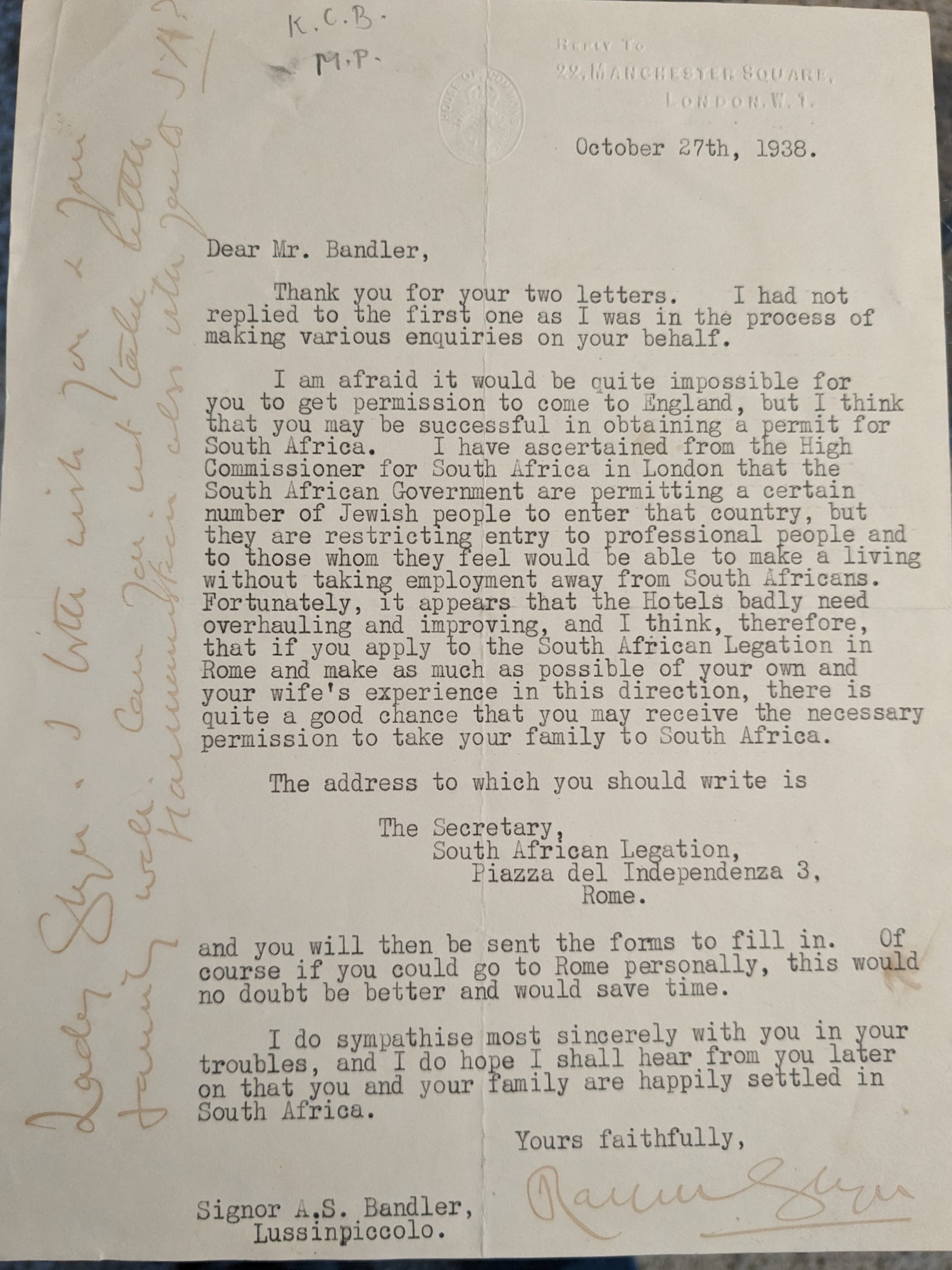
Letter to Alexander Bandler from Lord Ralph Glyn (Baron Glyn), in London, England, October 27, 1938. Lord and Lady Glyn had been guests at the Alhambra, to whom Alexander had turned asking for assistance in obtaining visas for himself and his family.
Courtesy of Barbara Bandler Steinmetz
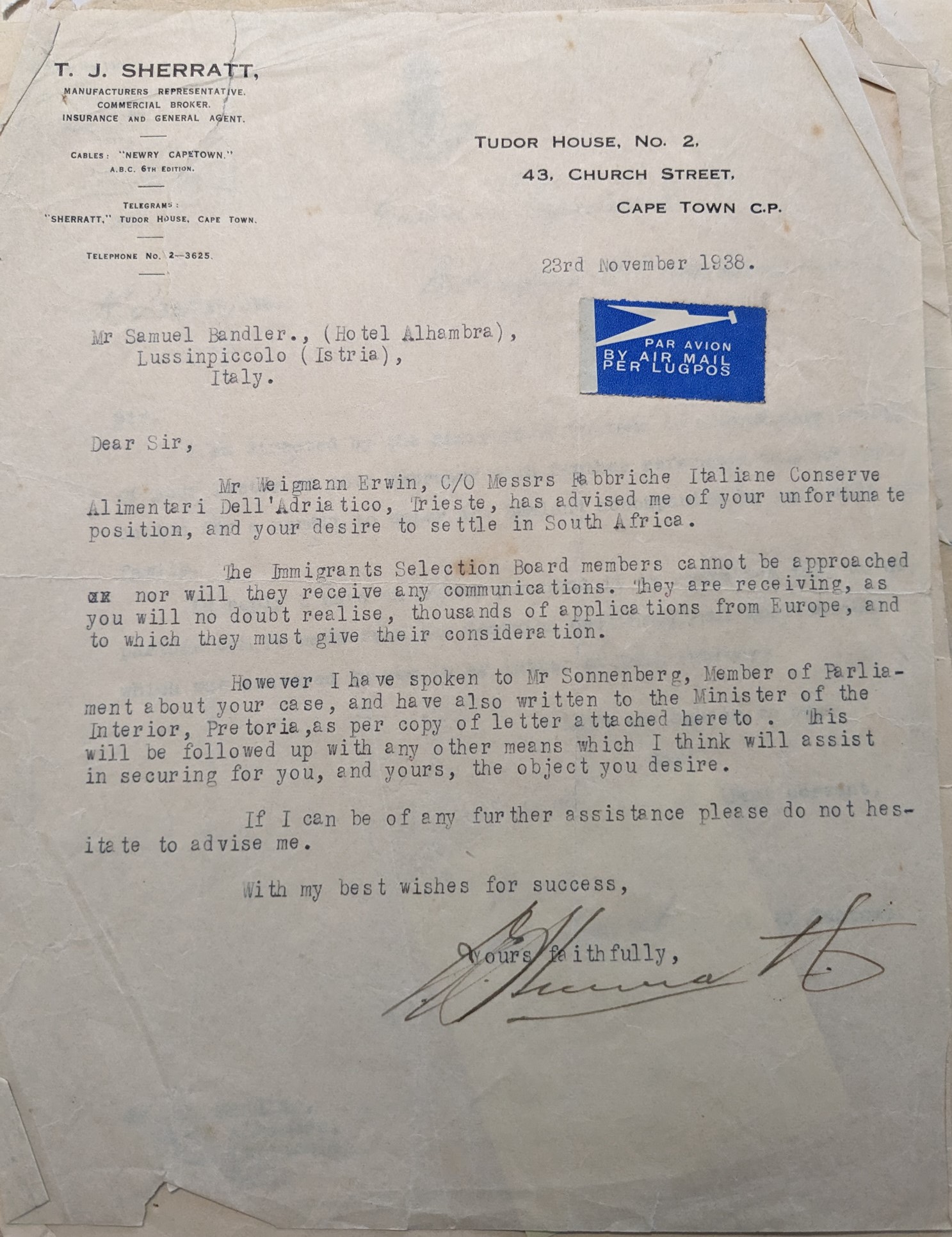
Letter to Alexander Bandler from T.J. Sherratt, a businessman in Cape Town, South Africa, November 23, 1938. Mr. Sherratt was contacted on the Bandlers' behalf to facilitate their visa application, but is unable to influence the matter.
Courtesy of Barbara Bandler Steinmetz
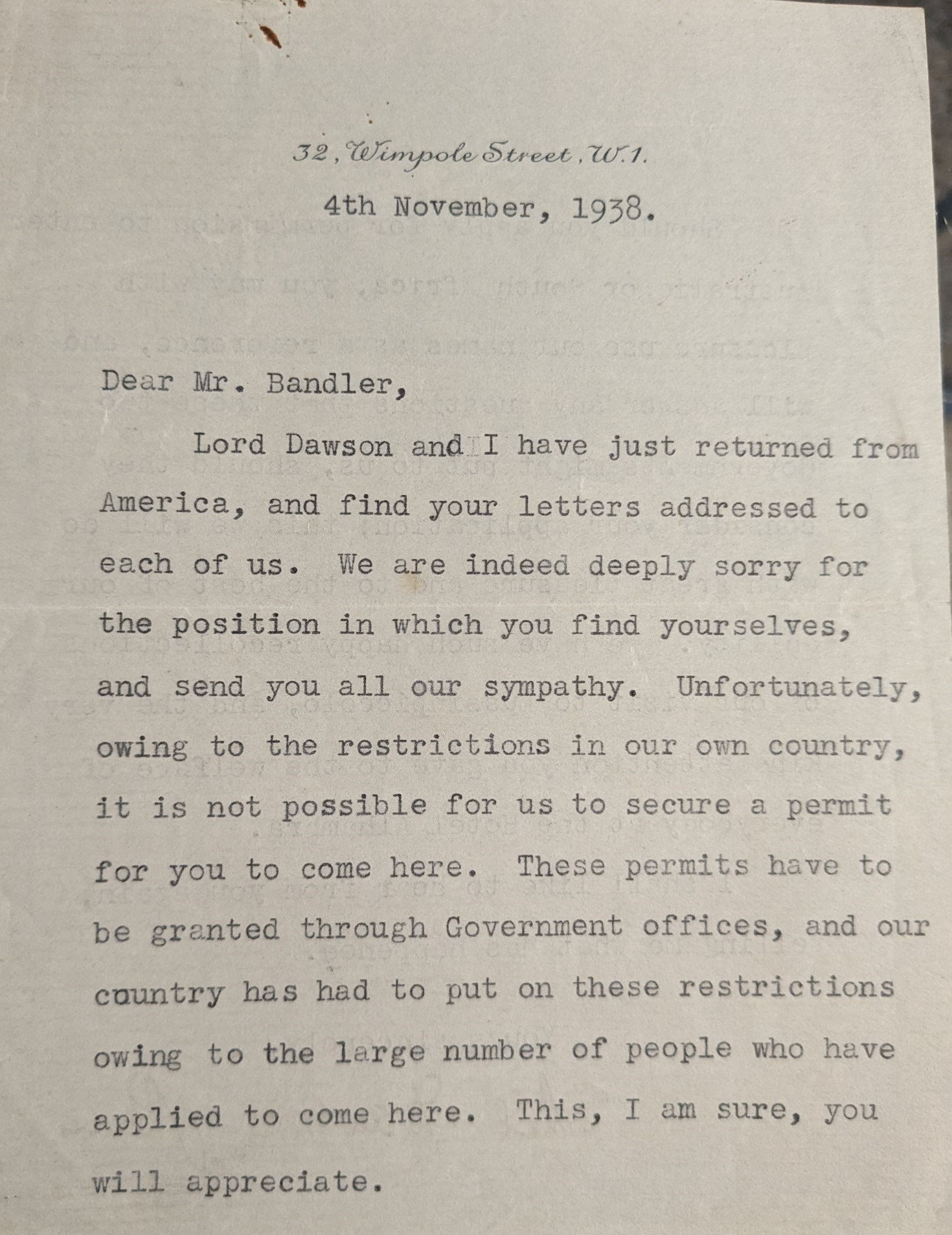
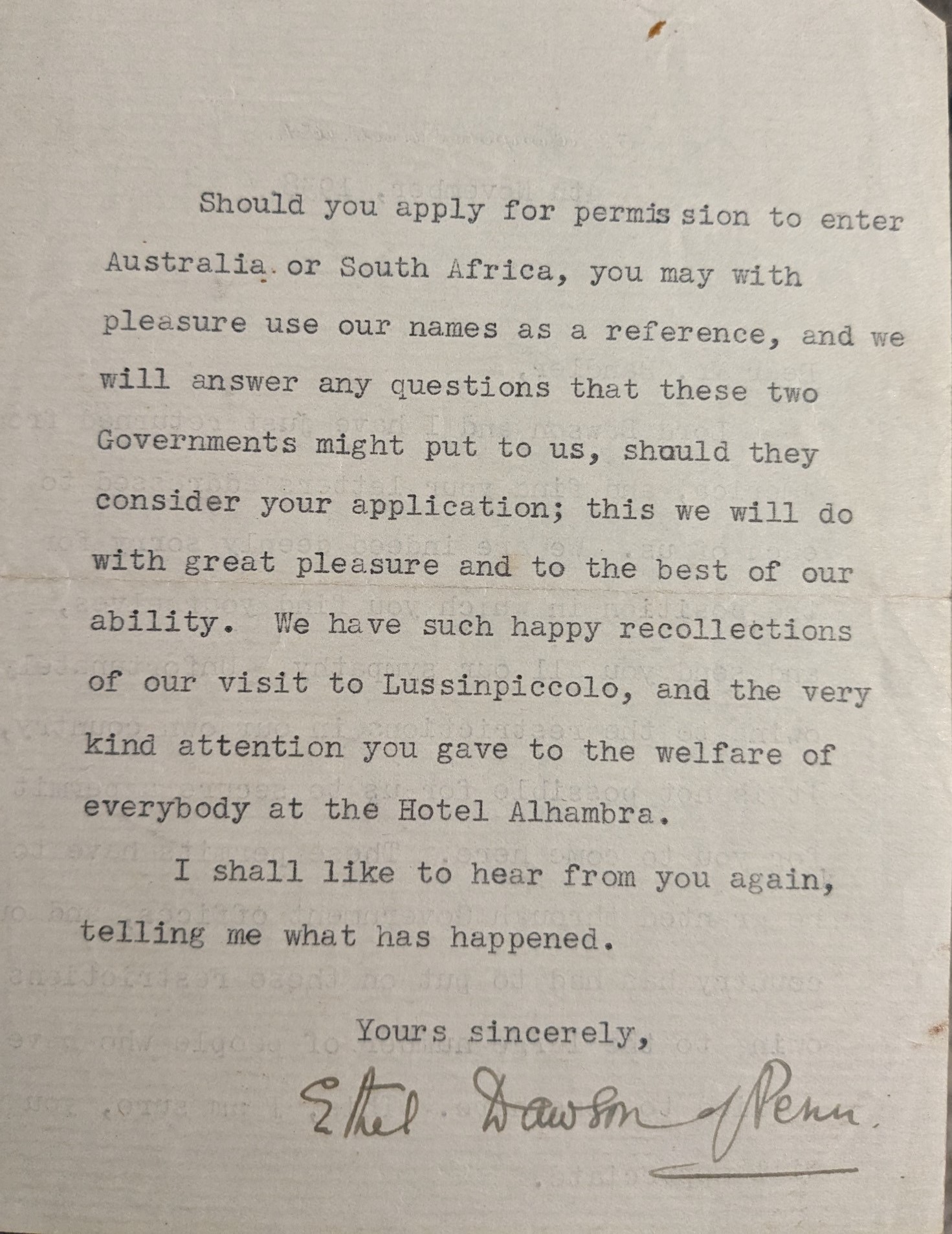
Letter from Lady Ethel Dawson of Penn, wife of Lord Bertrand Edward Dawson, responding to Alexander Bandler's request for assistance in obtaining visas for himself and his family. November 4, 1938.
Courtesy of Barbara Bandler Steinmetz
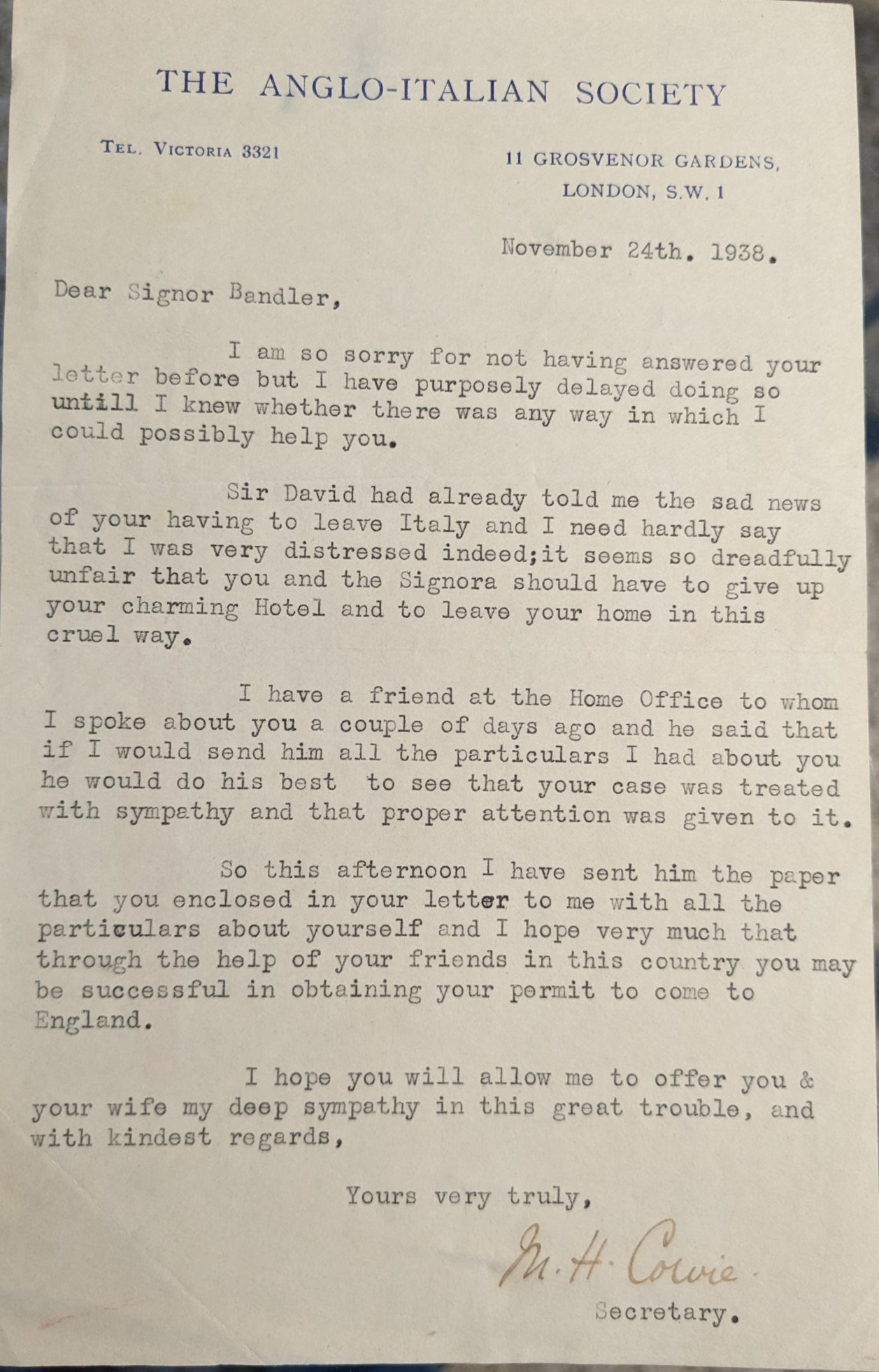
Letter from M. H. Corrie, Secretary of the Anglo-Italian Society in London, England, to Alexander Bandler in response to his letter requesting assistance in obtaining visas for himself and his family. November 24, 1938.
Courtesy of Barbara Bandler Steinmetz
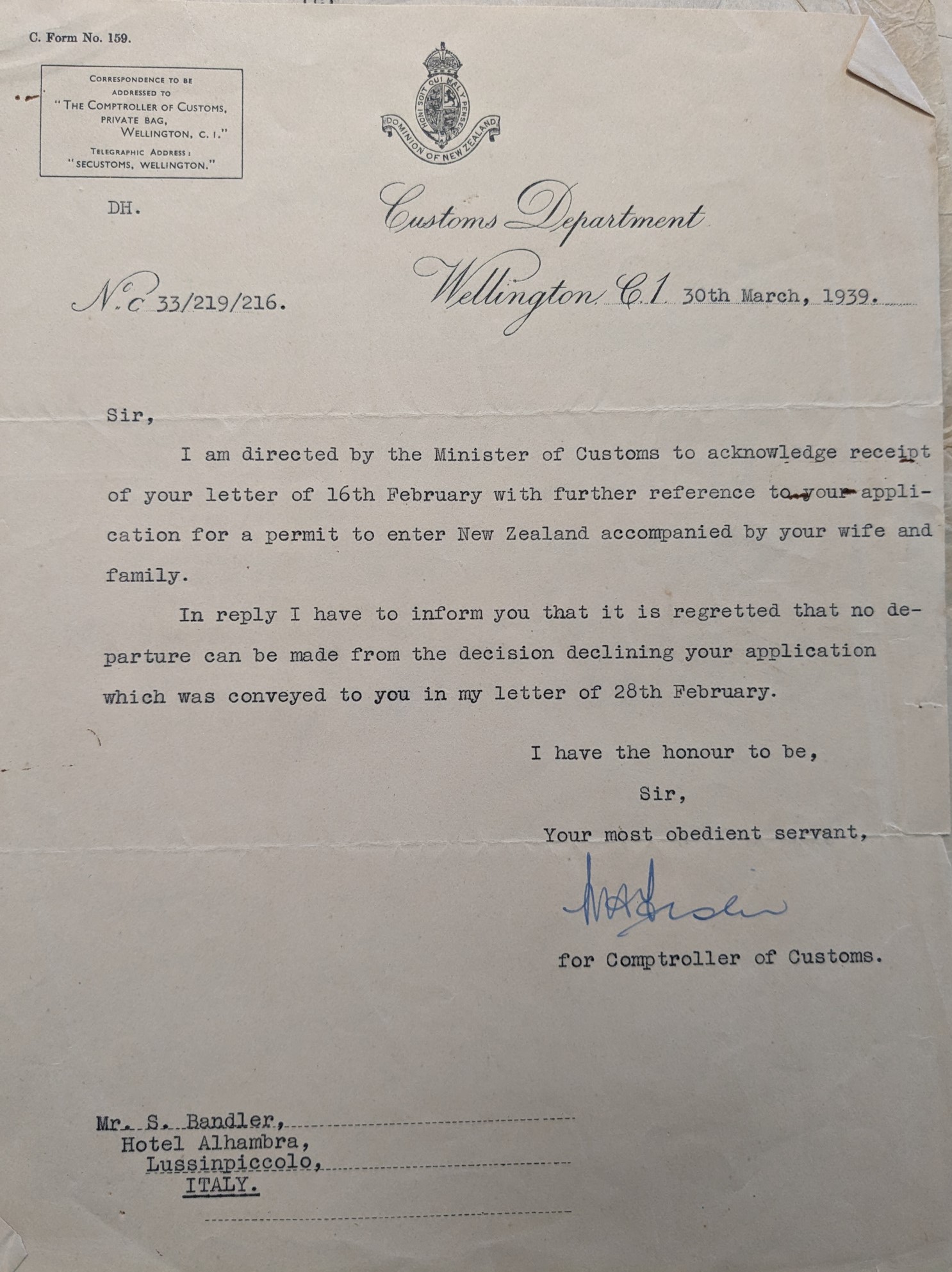
Letter from the New Zealand Customs Department in Wellington, N.Z. to Alexander Bandler, informing him that his application for a visa to New Zealand has been rejected. March 30, 1939.
Courtesy of Barbara Bandler Steinmetz
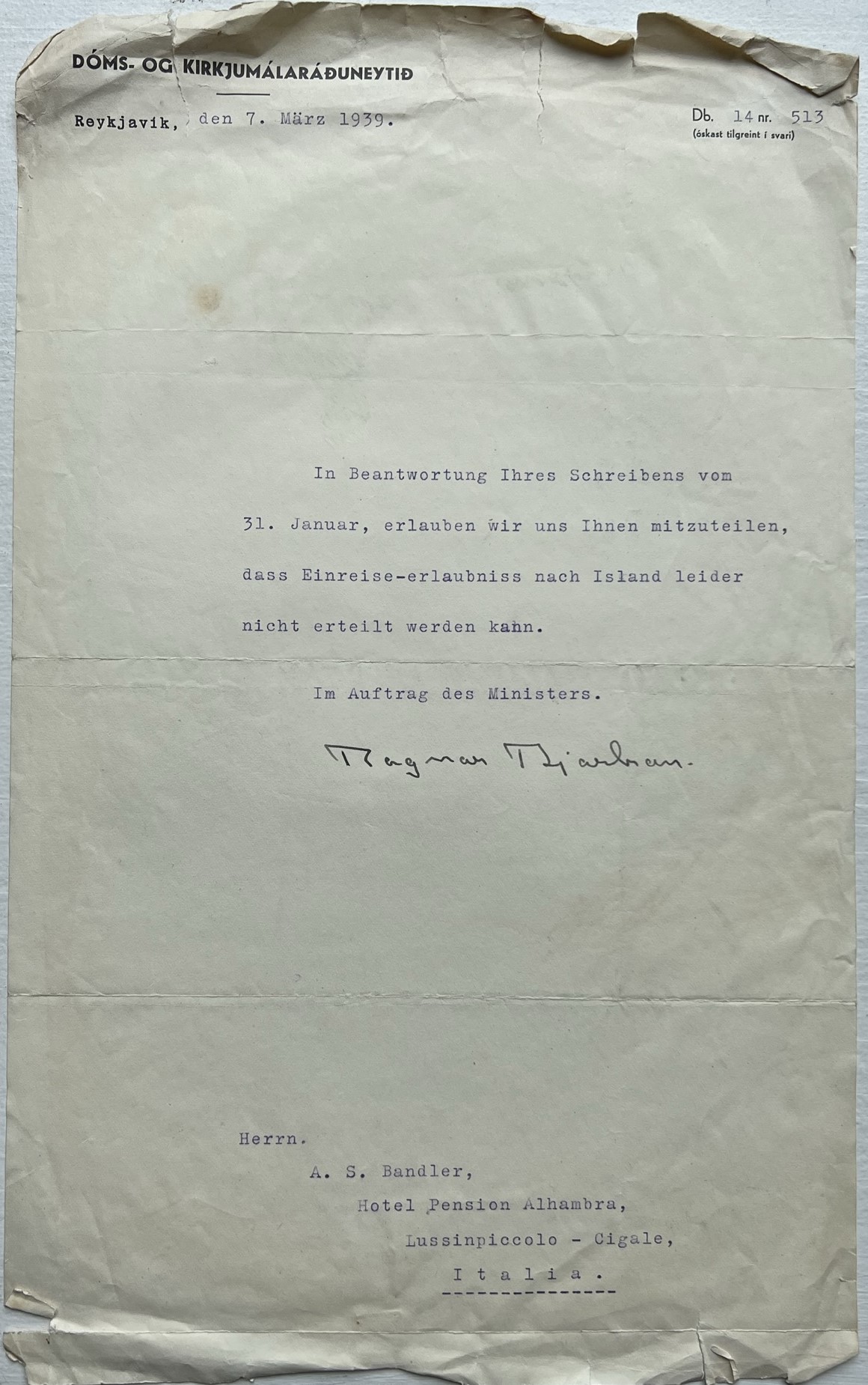
Letter from the Justice Ministry of Iceland to Alexander Bandler, written in German, informing him that his application for a visa to Iceland has been rejected. March 7, 1939.
Courtesy of Barbara Bandler Steinmetz
Ministry of Justice and Ecclesiastical Affairs
Reykjavik, March 7, 1939
Db. 14 No. 513 (please include in reply)
In response to your letter of January 31, we regretfully inform you that your application for a visa to Iceland cannot be approved.
On behalf of the Minister,
[signed]
Mr.
A.S. Bandler,
Hotel Pension Alhambra,
Lussinpiccolo - Cigale,
I t a l y.
Translation
Holocaust Awareness Institute
Barbara Bandler Steinmetz' Timeline
-
Rome-Berlin Axis Agreement
Italy, under fascist dictator Benito Mussolini, concludes an alliance with Germany's Hitler. Mussolini later issues anti-Jewish legislation and enforces persecution of Italian Jewish community.

-
Barbara Bandler is born in Győr, Hungary
Her parents, Margit and Alexander Bandler, are Hungarian citizens but live in Italy, where Alexander owns a hotel on the Adriatic island of Lussinpiccolo, just off the coast of what is today Croatia. They return to Italy soon after Barbara’s birth
-
Publication of the “Race Manifesto” in Italy
Published anonymously but drawn up by a scholar with close ties to the Fascist government, the article outlines in ten clauses a theoretical framework for the concept of race in Fascist Italy, according to which Italians are essentially Aryan and Jews do not belong to the Italian race.
-
Italy adopts antisemitic laws
Italy adopts a series of antisemitic “Race Laws.” A September 5, 1938 law prohibits Jews from studying or teaching at Italian public schools and universities. A September 7, 1938 law retroactively annuls Italian citizenship granted to Jewish immigrants to Italy after 1919 and revokes permanent residency in Italy for foreign Jews, requiring them to leave the country within six months. Like the Nuremberg Race Laws and other Nazi legislation, additional laws prohibits marriage between Jews and “Aryans,” define who is Jewish, and require all Italian Jews to register, as well as placing restrictions on professional activities and business ownership.
-
Italy and Germany sign the “Pact of Steel”
Expanding on the alliance between the two countries since the Rome-Berlin Axis of October 1936, in the “Pact of Steel” (officially the Pact of Friendship and Alliance) Italy and Germany agree to military cooperation and mutual defense. Despite this agreement, Italy remains neutral during the first year of the war, only entering the war as Germany’s ally in June 1940.
-
Rafael Trujillo and the American Jewish Joint Distribution Committee sign an agreement
The document formalized the first wave of Jewish immigration to a 26,000 acre agricultural settlement in Sosúa, on the northern coast of Hispaniola. The New York City-based American Jewish Joint Distribution Committee set up a separate arm, the Dominican Republic Settlement Association (DORSA), to establish Sosúa as an agricultural community.
-
France formally surrenders to Nazi Germany
Much of France falls to Nazi domination. Parts of southern France are governed by a Nazi collaborator government headed by Marshal Henri Philippe Pétain, called the "Vichy" regime after its capital.
-
Vichy France enacts anti-Jewish legislation
The collaborationist Vichy government enacts a series of anti-Jewish laws in accordance with Nazi policy.
-
Germany orders closure of US diplomatic missions
After the US State Department orders the closure of German consulates in the United States because German diplomats are suspected of spying, Germany and Italy order all American consulates in Axis-occupied Europe to cease operation, closing the door for refugees fleeing Nazi persecution to apply for immigration to the United States.
-
Bandlers set sail for the Dominican Republic
Aboard the Portuguese ship Nyassa, the family sail for the Caribbean, making a stop at Ellis Island on the way.
-
DORSA establishes a hotel in Jarabacoa, Dominican Republic for new Jewish settlers
Disease, fatigue, poor sanitation, the brutal sun, and the emotional distress of dislocation all take their toll on the island’s new Jewish residents. DORSA organizers recognize the need to provide ailing refugees with a place to recuperate from their exertions, and ask Alexander and Margit Bandler to manage the refuge.
-
The Battle of the Caribbean
In an attempt to disrupt the Allied supply of oil and other material by targeting their points of origin in the Caribbean, German and Italian submarines torpedoed 263 ships in the Caribbean, including two Dominican ships. The S. S. Presidente Trujillo and the San Rafael, both named by the Dominican president after himself, were sunk, and 25 crew members were killed.
-
Allies denounce Nazi mass murder of Jews
Reports of the Nazi plan to murder all of the Jewish people in Europe begin to circulate in the second half of 1942 and are widely reported in U.S. newspapers in late November. On December 17 1942, the Allied governments denounce the mass murder of European Jews under Nazi control. Though Nazi crimes are now publicized, Allied forces do not target Nazi killing installations or prioritize the rescue of Jews.
-
Ads for Margit Bandler’s cosmetics company appear in American Jewish newspapers
Lori (Elenor) Mayer, one of Margit’s childhood friends who had immigrated to Boston in the mid-1930s, sees the advertisement in 1945, and sends a letter to Margit in Jarabacoa. Lori and her husband, Eugene, later secure work visas for the Bandlers to enter the U.S.
-
Nazis install new fascist government in Hungary
Nazis arrest Hungarian leader Miklos Horthy and install a new government under Ferenc Szalasi, leader of the fascist and radically antisemitic Arrow Cross Party.
-
Mass executions of Budapest Jews
Between December 1944 and January 1945, approximately 20,000 Jews from Budapest's ghetto are taken to the banks of the Danube, where they are murdered and their bodies thrown into the river.
-
Soviet forces liberate Budapest
After nearly two months, Soviet forces succeed in liberating Budapest from Nazi and Hungarian fascist control. Approximately 100,000 Jews survive, mostly thanks to protections offered by foreign diplomats such as Raoul Wallenberg.
-
Bandler family leaves the Dominican Republic for the U.S.
With little notice, Barbara boards a bus to Santo Domingo, then a plane to Miami, FL, then another bus to Boston, MA where she and her family begin their new American life.
-
Sosúa project dwindles
By the late 1940s, only 275 settlers remain in Sosúa, which had once been home to many hundreds more refugees. DORSA’s experiment under Trujillo never becomes a profitable agricultural settlement, though a successful dairy cooperative founded by Jewish immigrants flourishes there for decades.
-
Hungarian People's Republic established
Soviet forces had remained in Hungary after liberating the country from Nazi occupation in 1944. After the war, Hungary had held democratic elections, but under Soviet influence the Communists successively neutralized all other parties until, in 1949, voters were presented with ballots with only one party list. The newly elected Communist legislature adopted a new, Soviet-style constitution and became a Soviet satellite.
-
Barbara becomes a U.S. citizen
Just a few months before her 16th birthday, Barbara takes the oath to become a United States citizen.
-
Barbara Bandler graduates high school
She and her boyfriend, Howard Steinmetz, make plans to wed, but her father insists she complete her college education before marrying. The two reach an agreement, and Barbara and Howard are married in 1956, after Barbara is accepted to college.
-
Hungarian Revolution of 1956
Student demonstrations in Budapest calling for political and social reforms grow into a broad-based, nationwide popular uprising against the Soviet-backed government of the Hungarian People's Republic. Despite the movement's initial success, the revolution is brutally crushed by Soviet military intervention. Some 200,000 people flee the country in the course of the revolution.
-
Rafael Trujillo assassinated
Trujillo’s reign grows notoriously bloody throughout the 1950s, though his repression is not felt in Sosúa. Still, political unrest, economic woes, and scandal plague the General’s rule. In May 1961, the embattled dictator is assassinated by a group of conspirators who ambushed his turquoise Chevrolet Bel Air. Trujillo’s death sets off a period of political instability in the Dominican Republic that drives many of the few remaining Jewish residents to emigrate.
-
Barbara and Howard move to Boulder, CO
After vacationing in Colorado for decades, the pair finally decide to settle permanently.