
Letter from Boston

Barbara Bandler Steinmetz
While Barbara and her sister study at the convent school, their parents remain busy. Margit is developing plans for a small business. During her medical studies in Hungary, she had researched casein, a type of protein found in milk and often used as a dietary supplement or food stabilizer. The industrious Margit considers deriving casein from Sosúa’s herd of dairy cows and using it to prevent the separation of ingredients in cosmetics. She hopes to manufacture quality hand cream and make-up in Jarabacoa with the help of the Dominican government and DORSA. The proceeds of their sales would allow the Bandlers more financial security. By mid-1942, Margit is actively seeking donations of equipment to launch her business. Want-ads appearing in American Jewish newspapers feature Margit’s name alongside a list of the items she seeks to start her venture. The Bandlers can only hope that some charitable reader in the U.S. will respond.
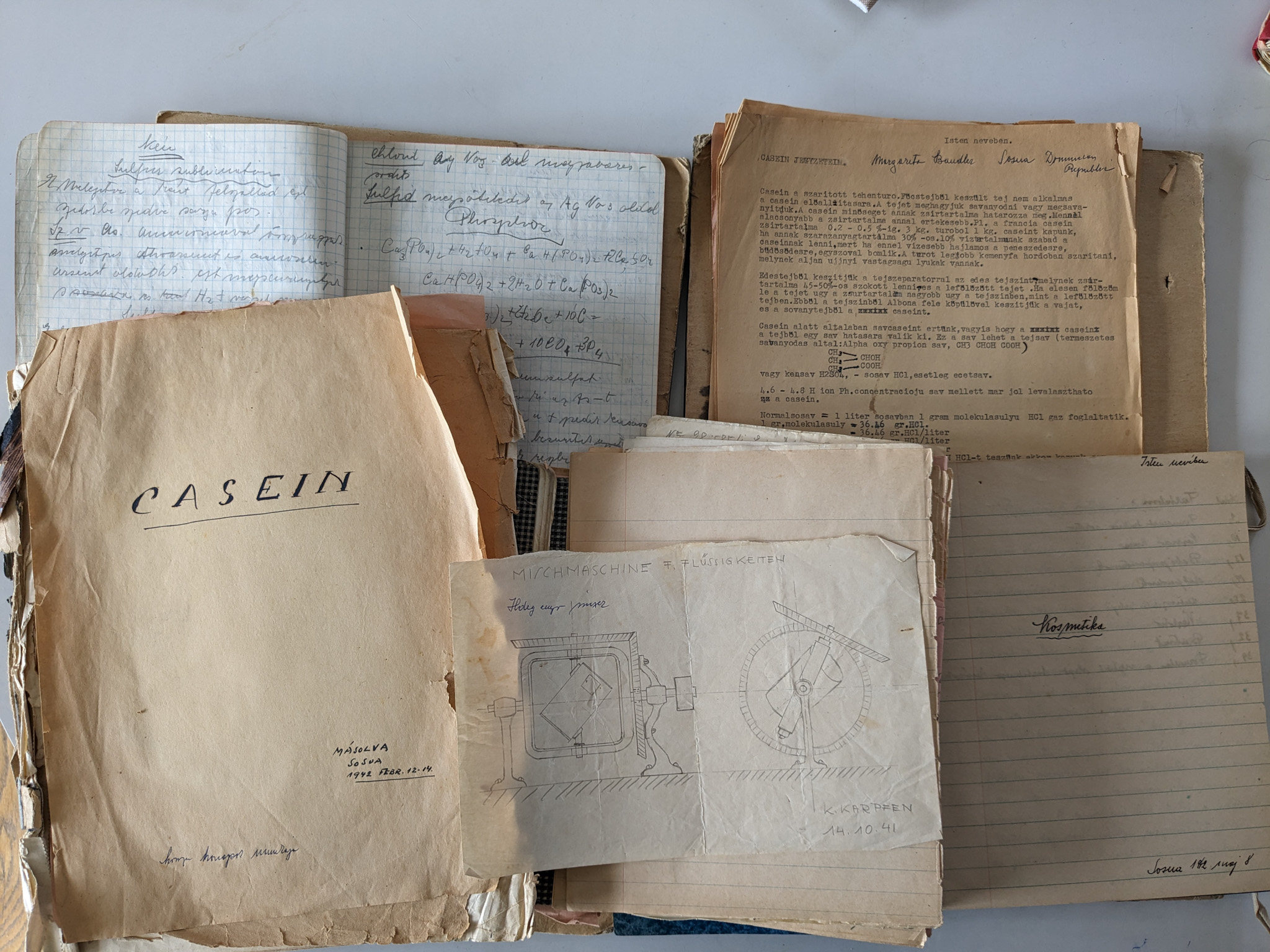
Margit Bandler's research on casein, which she hoped to use to manufacture cosmetic products in Jarabacoa.
Courtesy of Barbara Bandler Steinmetz
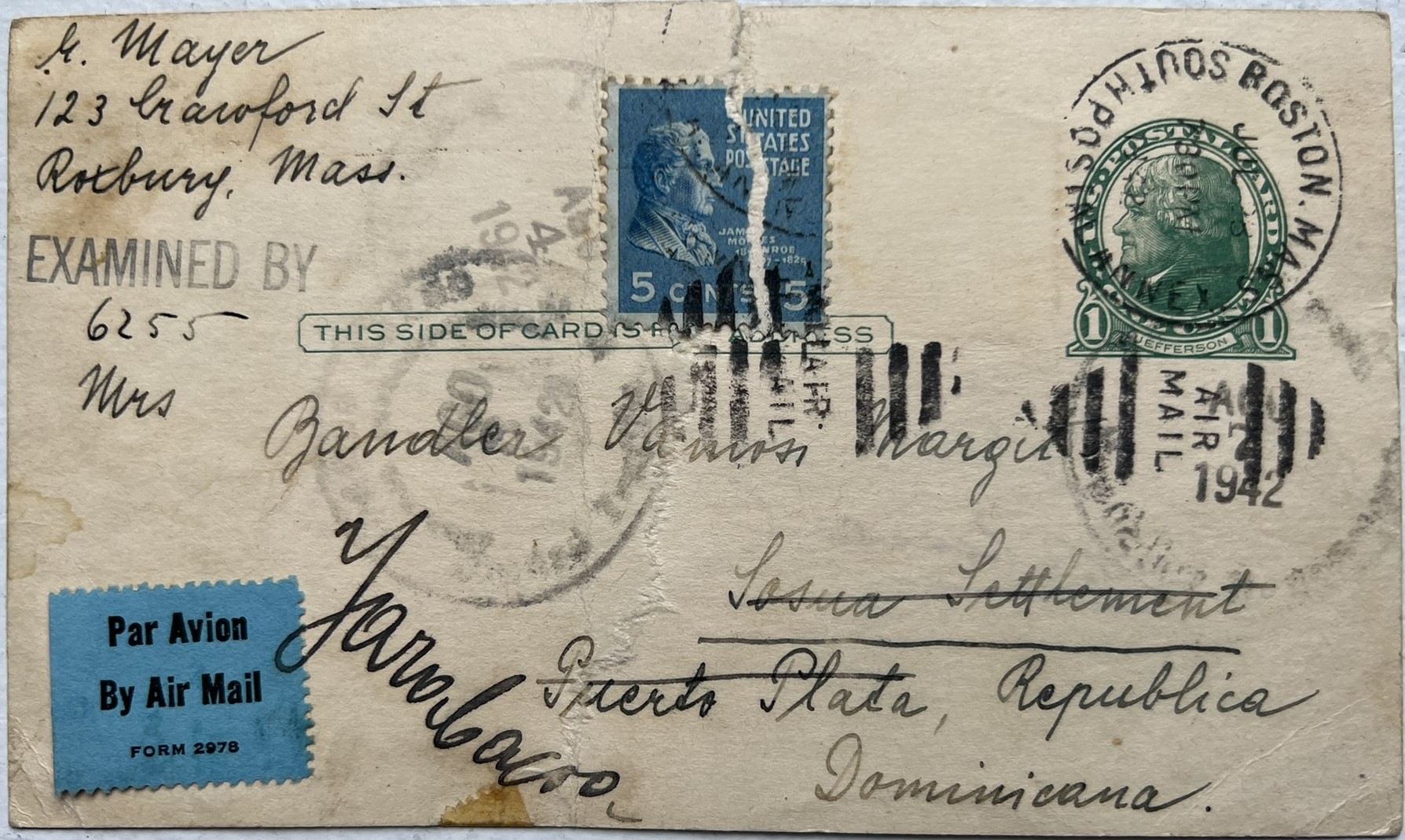
Letter to Margit Vamosi Bandler from her childhood friend, Elenor Mayer, who is living near Boston. Postmarked August 7, 1942.
Courtesy of Barbara Bandler Steinmetz
As the media begins to reveal the horrors of the Holocaust to the world, American Jews frantically scan newspapers to gather clues about the whereabouts of family and friends who are stranded in Europe. Lori (Elanor) Mayer, one of Margit’s childhood friends who had immigrated to Boston in the mid-1930s, is one of these desperate individuals who fears the worst for her family, from whom she has been cut off for years. She sends regular care packages to Hungary filled with lightweight, desirable goods—chocolate, cigarettes, nylon stockings—all carefully wrapped in newspaper. Such items were valuable to barter for food and other necessities amidst shortages in the shattered war economy. While Lori is wrapping a package, a scrap of newspaper—one of the advertisements bearing Margit’s name—catches her eye. She remembers Margit from their school days in Győr and immediately dispatches a letter to Jarabacoa.
Margit is thrilled to hear from her old friend. After years of anxiety and wandering, the connection with a part of her distant past rekindles hopes for a better future. Lori too is eager to reconnect. The destruction of European Jewry haunts Lori as it does others who escaped just in time. And like most of the European refugees who have come to the Dominican Republic, Margit and Alexander hope to find a path to the U.S., which offers a higher standard of living and a more robust Jewish community than Trujillo’s Caribbean haven. Although the Mayers are not well off themselves, Lori and her husband, Eugene, set to work to secure visas for the Bandlers, raising money in their Hungarian Jewish community of Roxbury, Massachusetts.
Transcript
Barbara: We-- we stayed in-- in the Dominican Republic until 1945. I mean, a number of things happened while we were there for my parents. First of all, my mother, as I said to you, was a chemist. And she had done work with casein, with milk products. And she had formulas for perfumes. And she was in contact with the Dominican government because they were going to set up a company and help her go into business. She had told them that this was-- that this would be a very good thing for the economy of the country. Somehow or other, and I don't know why, it just didn't work out. So she never did start the-- the perfume industry, or perfume business. I still have her booklet full of chemical formulas. But because of that, she needed some chemicals. She needed some additional materials. And so she wrote to a Jewish newspaper in the United States in the Boston area, or Boston-- probably New York. I don't remember just where. And she put an ad in asking for chemistry books because she needed to, I don't know, work out the formula. Somehow or other she needed to do something with-- with her chemistry.
At that time, there was a woman living in Boston who was an old, old girlhood friend of my father's and mother's. And as a matter of fact, she had dated my father as a young woman. And she was wrapping packages for Europe. She had come-- she and her husband and son-- her name was Elenor Mayer. Her husband's name was Eugene Mayer, and their son George. They had come to the United States sometime in the mid-'30s. And their life was very difficult in Boston. They lived in a little garret apartment, and she-- she was a seamstress, and she worked in a-- I don't know-- a bra factory, something like that. Anyhow, she was wrapping packages to send to Europe, and a name caught her eye, and the name Bandler. And she read the ad, and she immediately contacted my parents. And I don't know what year this was. I don't know whether it was 42 or '43. You know, I don't know. But I know that my parents obviously asked her what she could do to help us come to the United States.
As far as my parents were concerned, and probably most of the people that went to Sosua, that sought a haven in the Dominican Republic, that no sooner did they get there that they knew that their life, way into the future, was not going to be in the Dominican Republic. That if-- if the war was over, when the war was over, that somehow or other they were going to make their way back. You know, this was, as I said, a very primitive land. And this was not where these Europeans saw themselves for the rest of their days, my father included. Not only that, but in Jarabacoa, there was not going to be a Jewish life for his children, and really a Jewish education. The education that they were-- that we were receiving was OK for now. But obviously my parents were not in this place for the long haul. So they immediately asked her to start working toward getting us into the United States.
My uncle Eugene, who we saw when we were in Ellis Island, he was unable to help us because he-- he was a waiter. He was-- he was living in a-- in a rented, furnished room. He was not-- he didn't have any contacts. He had a hard time with the language. He was not in any position to really help us. My mother's cousin, who also-- who gave us the dolls on Ellis Island, they were unwilling to help us.
And so Elenor Mayer, since she was our first contact-- and she-- she was a terrific lady. And although they didn't have the funds or the know-how as to how to get us to this country, she knew someone that did. She attended a synagogue in Roxbury, Boston, Massachusetts. And the cantor there was a man called Cantor Glickstein. And he was-- not only was he a chazzan, but he was-- he was like the leader in the Hungarian Jewish community. And he was-- he was like a tzadik. He was a great man. He was a wonderful, warm, loving person. And she implored to him to see what he could do to get us to this country. And so we started. My father started once again, you know, with the letters of reference, you know, as to who we are and what we do, and that my mother is a chemist, and that he is a--and a pharmacologist-- and that he is a-- a-- a hotel owner, and that he would be able to run a hotel, and that he would not be a burden to anyone in this country, that he would come here. And he would be an exemplary-- that we would be exemplary citizens worthy of coming to the United States.
"...no sooner did they get there that they knew that their life, way into the future, was not going to be in the Dominican Republic..."
USC Shoah Foundation Visual History Archive, Interview 38619
While the Bandlers are pursuing their immigration to the United States with the help of Lori Mayer, the situation for their families in Hungary is deteriorating. Since Hungary joined the Axis in 1941, Hungarian troops fighting alongside the German Wehrmacht in the attack on the Soviet Union have suffered massive losses in the Battle of Stalingrad. Hungarian leader Miklos Horthy is convinced that Germany will lose the war after the devastating Nazi defeat at Stalingrad in February 1943, and leads his government to begin negotiations with the Allies. When Germany learns of Hungary’s efforts to switch sides, Nazi forces invade the country in March 1944.
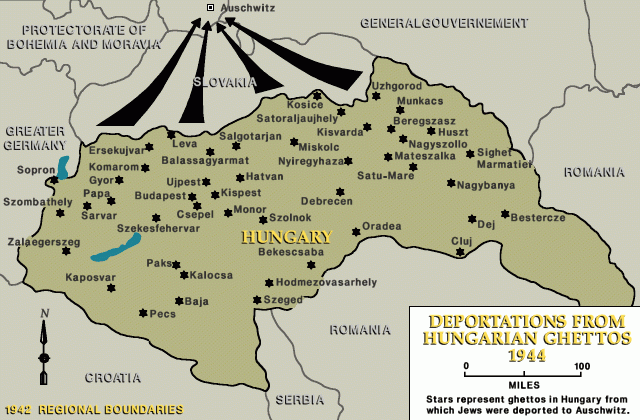
Deportations from Hungarian ghettos created under Nazi occupation in 1944.
Practically overnight, the situation for Hungary’s Jewish population takes a drastic turn for the worse. Up until this point, Hungarian Jews have been subjected to discriminatory racial legislation, but Horthy has refused to deport Jews despite mounting pressure from the German government. Now the German occupiers immediately begin registering the c. 800,000 Jews in the country and forcing them to relocate from rural areas into urban centers, where they are concentrated in ghettos.
By May, the Jewish population is facing massive deportations. When Horthy refuses, German occupiers engineer a coup d’etat. Horthy is arrested in October 1944 and a new government is installed led by Ference Szalasi, leader of the Hungarian fascist and antisemitic Arrow Cross party. By this time, the only Jewish community remaining is in Budapest, and they face a reign of terror at the hands of the Arrow Cross. Approximately half of Hungary’s Jews will be deported to Auschwitz in the summer of 1944. In the final months of the war, about 70% of Hungary’s Jews will ultimately be murdered.
Barbara Bandler Steinmetz' Timeline
-
Rome-Berlin Axis Agreement
Italy, under fascist dictator Benito Mussolini, concludes an alliance with Germany's Hitler. Mussolini later issues anti-Jewish legislation and enforces persecution of Italian Jewish community.

-
Barbara Bandler is born in Győr, Hungary
Her parents, Margit and Alexander Bandler, are Hungarian citizens but live in Italy, where Alexander owns a hotel on the Adriatic island of Lussinpiccolo, just off the coast of what is today Croatia. They return to Italy soon after Barbara’s birth
-
Publication of the “Race Manifesto” in Italy
Published anonymously but drawn up by a scholar with close ties to the Fascist government, the article outlines in ten clauses a theoretical framework for the concept of race in Fascist Italy, according to which Italians are essentially Aryan and Jews do not belong to the Italian race.
-
Italy adopts antisemitic laws
Italy adopts a series of antisemitic “Race Laws.” A September 5, 1938 law prohibits Jews from studying or teaching at Italian public schools and universities. A September 7, 1938 law retroactively annuls Italian citizenship granted to Jewish immigrants to Italy after 1919 and revokes permanent residency in Italy for foreign Jews, requiring them to leave the country within six months. Like the Nuremberg Race Laws and other Nazi legislation, additional laws prohibits marriage between Jews and “Aryans,” define who is Jewish, and require all Italian Jews to register, as well as placing restrictions on professional activities and business ownership.
-
Italy and Germany sign the “Pact of Steel”
Expanding on the alliance between the two countries since the Rome-Berlin Axis of October 1936, in the “Pact of Steel” (officially the Pact of Friendship and Alliance) Italy and Germany agree to military cooperation and mutual defense. Despite this agreement, Italy remains neutral during the first year of the war, only entering the war as Germany’s ally in June 1940.
-
Rafael Trujillo and the American Jewish Joint Distribution Committee sign an agreement
The document formalized the first wave of Jewish immigration to a 26,000 acre agricultural settlement in Sosúa, on the northern coast of Hispaniola. The New York City-based American Jewish Joint Distribution Committee set up a separate arm, the Dominican Republic Settlement Association (DORSA), to establish Sosúa as an agricultural community.
-
France formally surrenders to Nazi Germany
Much of France falls to Nazi domination. Parts of southern France are governed by a Nazi collaborator government headed by Marshal Henri Philippe Pétain, called the "Vichy" regime after its capital.
-
Vichy France enacts anti-Jewish legislation
The collaborationist Vichy government enacts a series of anti-Jewish laws in accordance with Nazi policy.
-
Germany orders closure of US diplomatic missions
After the US State Department orders the closure of German consulates in the United States because German diplomats are suspected of spying, Germany and Italy order all American consulates in Axis-occupied Europe to cease operation, closing the door for refugees fleeing Nazi persecution to apply for immigration to the United States.
-
Bandlers set sail for the Dominican Republic
Aboard the Portuguese ship Nyassa, the family sail for the Caribbean, making a stop at Ellis Island on the way.
-
DORSA establishes a hotel in Jarabacoa, Dominican Republic for new Jewish settlers
Disease, fatigue, poor sanitation, the brutal sun, and the emotional distress of dislocation all take their toll on the island’s new Jewish residents. DORSA organizers recognize the need to provide ailing refugees with a place to recuperate from their exertions, and ask Alexander and Margit Bandler to manage the refuge.
-
The Battle of the Caribbean
In an attempt to disrupt the Allied supply of oil and other material by targeting their points of origin in the Caribbean, German and Italian submarines torpedoed 263 ships in the Caribbean, including two Dominican ships. The S. S. Presidente Trujillo and the San Rafael, both named by the Dominican president after himself, were sunk, and 25 crew members were killed.
-
Allies denounce Nazi mass murder of Jews
Reports of the Nazi plan to murder all of the Jewish people in Europe begin to circulate in the second half of 1942 and are widely reported in U.S. newspapers in late November. On December 17 1942, the Allied governments denounce the mass murder of European Jews under Nazi control. Though Nazi crimes are now publicized, Allied forces do not target Nazi killing installations or prioritize the rescue of Jews.
-
Ads for Margit Bandler’s cosmetics company appear in American Jewish newspapers
Lori (Elenor) Mayer, one of Margit’s childhood friends who had immigrated to Boston in the mid-1930s, sees the advertisement in 1945, and sends a letter to Margit in Jarabacoa. Lori and her husband, Eugene, later secure work visas for the Bandlers to enter the U.S.
-
Nazis install new fascist government in Hungary
Nazis arrest Hungarian leader Miklos Horthy and install a new government under Ferenc Szalasi, leader of the fascist and radically antisemitic Arrow Cross Party.
-
Mass executions of Budapest Jews
Between December 1944 and January 1945, approximately 20,000 Jews from Budapest's ghetto are taken to the banks of the Danube, where they are murdered and their bodies thrown into the river.
-
Soviet forces liberate Budapest
After nearly two months, Soviet forces succeed in liberating Budapest from Nazi and Hungarian fascist control. Approximately 100,000 Jews survive, mostly thanks to protections offered by foreign diplomats such as Raoul Wallenberg.
-
Bandler family leaves the Dominican Republic for the U.S.
With little notice, Barbara boards a bus to Santo Domingo, then a plane to Miami, FL, then another bus to Boston, MA where she and her family begin their new American life.
-
Sosúa project dwindles
By the late 1940s, only 275 settlers remain in Sosúa, which had once been home to many hundreds more refugees. DORSA’s experiment under Trujillo never becomes a profitable agricultural settlement, though a successful dairy cooperative founded by Jewish immigrants flourishes there for decades.
-
Hungarian People's Republic established
Soviet forces had remained in Hungary after liberating the country from Nazi occupation in 1944. After the war, Hungary had held democratic elections, but under Soviet influence the Communists successively neutralized all other parties until, in 1949, voters were presented with ballots with only one party list. The newly elected Communist legislature adopted a new, Soviet-style constitution and became a Soviet satellite.
-
Barbara becomes a U.S. citizen
Just a few months before her 16th birthday, Barbara takes the oath to become a United States citizen.
-
Barbara Bandler graduates high school
She and her boyfriend, Howard Steinmetz, make plans to wed, but her father insists she complete her college education before marrying. The two reach an agreement, and Barbara and Howard are married in 1956, after Barbara is accepted to college.
-
Hungarian Revolution of 1956
Student demonstrations in Budapest calling for political and social reforms grow into a broad-based, nationwide popular uprising against the Soviet-backed government of the Hungarian People's Republic. Despite the movement's initial success, the revolution is brutally crushed by Soviet military intervention. Some 200,000 people flee the country in the course of the revolution.
-
Rafael Trujillo assassinated
Trujillo’s reign grows notoriously bloody throughout the 1950s, though his repression is not felt in Sosúa. Still, political unrest, economic woes, and scandal plague the General’s rule. In May 1961, the embattled dictator is assassinated by a group of conspirators who ambushed his turquoise Chevrolet Bel Air. Trujillo’s death sets off a period of political instability in the Dominican Republic that drives many of the few remaining Jewish residents to emigrate.
-
Barbara and Howard move to Boulder, CO
After vacationing in Colorado for decades, the pair finally decide to settle permanently.