
A Catholic education

Barbara Bandler Steinmetz
Other than the Bandlers, the only European living in the vicinity of Jarabacoa is a Catholic priest they only refer to as “Padre.” The Bandlers establish a friendly relationship with him, and he soon introduces them to a nun, Madre Ascención, who operates a convent school for girls, Colegio Inmaculada Concepción, in the neighboring town of La Vega. Madre Ascención agrees to accept Barbara and Ann as students at the boarding school provided that neither of the two girls, nor anyone else, reveal that they are Jewish. No one is to know where Barbara and Ann have come from, or how it is that they find themselves in the mountainous interior of the Dominican Republic.
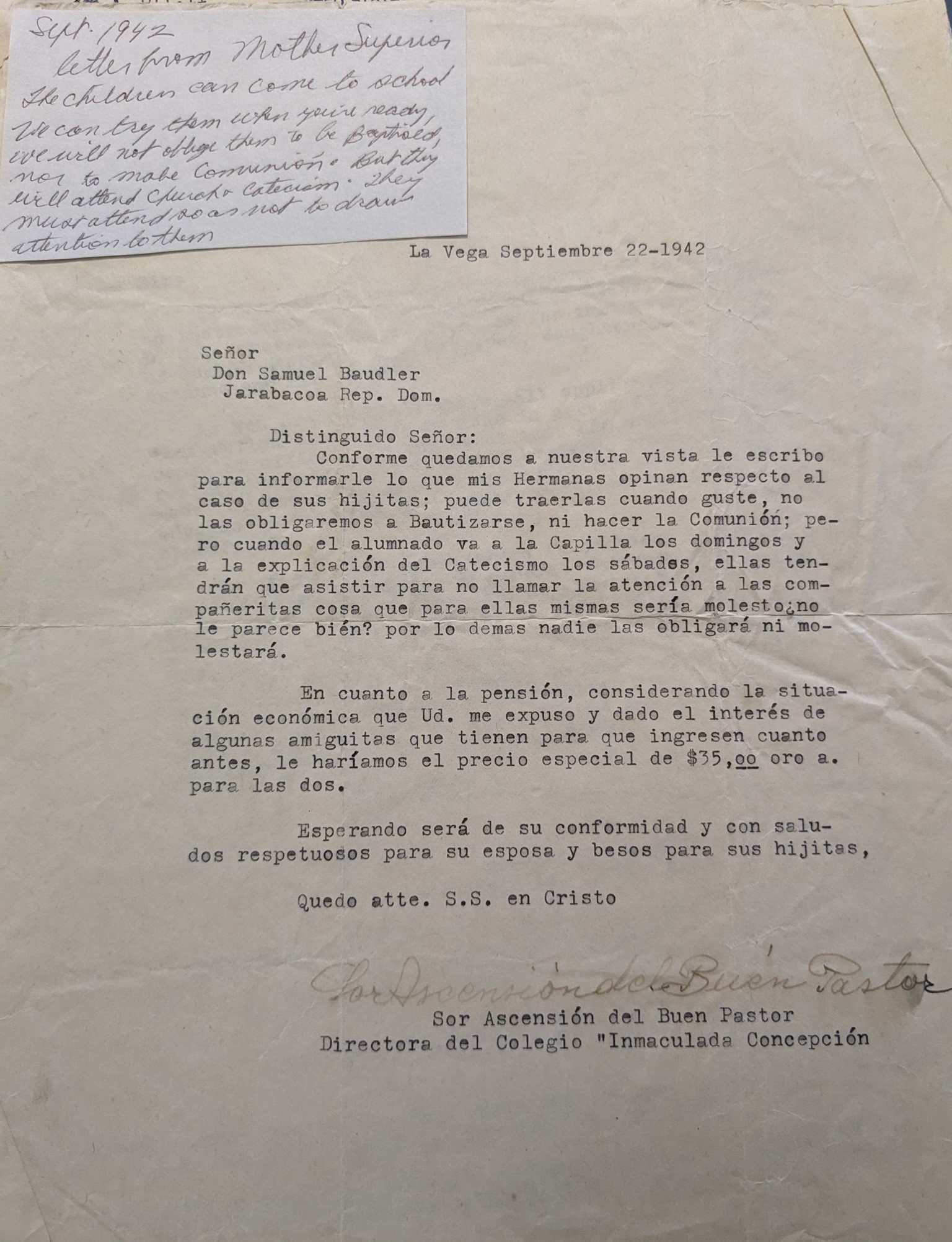
Letter from the director of the Colegio Inmaculada Concepcion dated September 22, 1942.
Courtesy of Barbara Bandler Steinmetz
La Vega, September 22, 1942
Sir
Mr. Samuel Baudler [sic]
Jarabacoa Dominican Republic
Distinguished Sir:
As we come into view, I write to you to inform you of what my Sisters think regarding the case of your daughters. You can bring them if you like; we will not force them to be baptized or take communion. But when the students go to the chapel on Sundays and to catechism class on Saturdays, they will also have to attend, so as not to attract the attention of their classmates, which could be annoying for them, don't you agree? For the rest, no one will coerce them or bother them.
Regarding the pension, considering the economic situation that you explained to me and given the interest of some of my friends to have them join us as soon as possible, we would offer the special price of $35.00 gold. for both.
In hopes that this will meet with your agreement, and with respectful greetings to your wife and kisses for your little girls,
I remain in attendance of the Holy Spirit of Christ,
Sister Ascension del Buen Pastor
Director of the College “Immaculate Conception”
Translation
Holocaust Awareness Institute
Though Barbara has been sworn to conceal her heritage, she regards Madre Ascención’s willingness to enroll her and her sister in the school as “an act of courage.” The mother superior could indeed be reprimanded for accepting unbaptized students in her school. Not all of those in the Catholic hierarchy are inclined to aid the Jewish refugees. At first, Barbara is terrified to be separated from her parents, but once acclimated to her new surroundings, she enjoys her time at the Colegio Inmaculada. She and her classmates rollerskate through the convent and play games of tag in the courtyard where a statue of the Virgin Mary serves as “base.” Years later, Barbara can still recite several prayers in Spanish by heart.
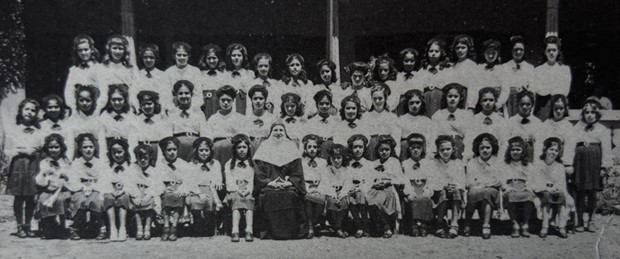
Ann (front row, 1st from right) and Barbara (front row, 8th from right) at La Escuela de Inmaculado Concepcion, La Vega.
Courtesy of Barbara Bandler Steinmetz
Transcript
Barbara: As you-- as you know, schooling is terribly important. And since we were living in this isolated part of the world, my parents had to find an appropriate school. And what they found was something that was-- the closest thing was a school in a town called La Vega, which I'm going to guess is about 25, 30, 40 miles from Jarabacoa, down the mountain.
And it is a--a school run by Catholic nuns, nuns from Spain. And so my father wrote to them inquiring as to whether their daughters, his daughters, could go to that school. And the response from the Mother Superior was that yes, we could come to the school. However, there were some stipulations. We had to go to church every day. We had to go to catechism every week. We did not have to take communion, and we did not have to be baptized, and that no one was to know that we were Jewish because it was not--it was not going to be a good thing for us, but that she wanted us to go to church every day because she did not want the taunts of-- she didn't want the other children to taunt us. And she didn't want us to stand out from the other children. She didn't think that that was a good thing.
Interviewer: How many Jewish children in the school?
Barbara: We were it. My sister and I, we were the Jewish kids. And so September of 1942, my sister and I and my mom got on horseback, because that was our only means of transportation, with our few belongings. And we went by horse to-- up to the school. Now I have to tell you that-- that this was probably the first time I had ever seen nuns in full habit. And that was a rather frightening experience for a not quite five-year-old. And-- and so I was--was very frightened by the experience. Also, it was very austere-looking. All the children were in uniforms. And it was a boarding school, obviously. My parents were going to leave us at that school. Now one-- one of the things that had always been, my parents were always, always with us through all of our trips, from Italy, to Hungary, to Nice, to Lisbon, to Ellis Island, to Sosua. There was one thing that was permanent in my 4 and 1/2 years of existence, and that was having my mother and father. And even though the world around me might have been crashing, and maybe every year I was in a country that had a different language, but my parents were always there. And they were leaving us now in a foreign country with a foreign language with people that looked really, really different. We didn't know a soul, and it was terribly, terribly traumatic.
"And even though the world around me might have been crashing, and maybe every year I was in a country that had a different language, but my parents were always there."
USC Shoah Foundation Visual History Archive, Interview 38619
Transcript
Barbara: The school was-- was really a very wonderful school. The nuns were warm, loving, caring, well-educated. My sister and I had a wonderful, wonderful education at the school. It--we played great games in the school. There was a-- there was a wonderful statue of the Virgin Mary in the courtyard. And that's where we played tag, and the Virgin Mary was it. I mean, that we had to touch it in order-- and then we--we would hide under the benches. And there was a grotto at the-- when you first walked into the school, there was a beautiful, beautiful grotto. And I would stand at the grotto because it was just covered with-- with greens and candles, and it was-- it was just wonderful and beautiful.
And I learned to love going to church every morning. There is-- there is a mystique about the Catholic church, and particularly the Catholic church in Latin American countries because it's-- it's practiced in the old way. There is-- the-- the priest comes in with his very fancy clothes and followed by altar boys with incense, and the church gets filled with incense. And to a young child that was pushed from hither and yon, it-- it represented stability. And I-- I remember loving the smell of the incense in the church. And I loved-- I loved the-- the regularity of life. I loved knowing what I had to do every day and who was going to be there. There was a permanence. We- -we rarely went out of the school. The school-- we slept at the school. We ate at the school. We-- we, obviously, we went to school. I had piano lessons in the school. We played in the yard. And everything was within the gates of the school. There were-- there was like a high fence around the entire property, which totally separated it from the rest of the world. And it was-- it was like being in a haven. And for three years we went to school in this haven. And it-- it provided a stability that I had never known before. And I loved it.
[...]
Interviewer: During this time, did you have any Jewish identity?
Barbara: I knew that I was Jewish. I never said anything to anyone about it.
"...for three years we went to school in this haven. And it-- it provided a stability that I had never known before. And I loved it. "
USC Shoah Foundation Visual History Archive, Interview 38619
Barbara Bandler Steinmetz' Timeline
-
Rome-Berlin Axis Agreement
Italy, under fascist dictator Benito Mussolini, concludes an alliance with Germany's Hitler. Mussolini later issues anti-Jewish legislation and enforces persecution of Italian Jewish community.

-
Barbara Bandler is born in Győr, Hungary
Her parents, Margit and Alexander Bandler, are Hungarian citizens but live in Italy, where Alexander owns a hotel on the Adriatic island of Lussinpiccolo, just off the coast of what is today Croatia. They return to Italy soon after Barbara’s birth
-
Publication of the “Race Manifesto” in Italy
Published anonymously but drawn up by a scholar with close ties to the Fascist government, the article outlines in ten clauses a theoretical framework for the concept of race in Fascist Italy, according to which Italians are essentially Aryan and Jews do not belong to the Italian race.
-
Italy adopts antisemitic laws
Italy adopts a series of antisemitic “Race Laws.” A September 5, 1938 law prohibits Jews from studying or teaching at Italian public schools and universities. A September 7, 1938 law retroactively annuls Italian citizenship granted to Jewish immigrants to Italy after 1919 and revokes permanent residency in Italy for foreign Jews, requiring them to leave the country within six months. Like the Nuremberg Race Laws and other Nazi legislation, additional laws prohibits marriage between Jews and “Aryans,” define who is Jewish, and require all Italian Jews to register, as well as placing restrictions on professional activities and business ownership.
-
Italy and Germany sign the “Pact of Steel”
Expanding on the alliance between the two countries since the Rome-Berlin Axis of October 1936, in the “Pact of Steel” (officially the Pact of Friendship and Alliance) Italy and Germany agree to military cooperation and mutual defense. Despite this agreement, Italy remains neutral during the first year of the war, only entering the war as Germany’s ally in June 1940.
-
Rafael Trujillo and the American Jewish Joint Distribution Committee sign an agreement
The document formalized the first wave of Jewish immigration to a 26,000 acre agricultural settlement in Sosúa, on the northern coast of Hispaniola. The New York City-based American Jewish Joint Distribution Committee set up a separate arm, the Dominican Republic Settlement Association (DORSA), to establish Sosúa as an agricultural community.
-
France formally surrenders to Nazi Germany
Much of France falls to Nazi domination. Parts of southern France are governed by a Nazi collaborator government headed by Marshal Henri Philippe Pétain, called the "Vichy" regime after its capital.
-
Vichy France enacts anti-Jewish legislation
The collaborationist Vichy government enacts a series of anti-Jewish laws in accordance with Nazi policy.
-
Germany orders closure of US diplomatic missions
After the US State Department orders the closure of German consulates in the United States because German diplomats are suspected of spying, Germany and Italy order all American consulates in Axis-occupied Europe to cease operation, closing the door for refugees fleeing Nazi persecution to apply for immigration to the United States.
-
Bandlers set sail for the Dominican Republic
Aboard the Portuguese ship Nyassa, the family sail for the Caribbean, making a stop at Ellis Island on the way.
-
DORSA establishes a hotel in Jarabacoa, Dominican Republic for new Jewish settlers
Disease, fatigue, poor sanitation, the brutal sun, and the emotional distress of dislocation all take their toll on the island’s new Jewish residents. DORSA organizers recognize the need to provide ailing refugees with a place to recuperate from their exertions, and ask Alexander and Margit Bandler to manage the refuge.
-
The Battle of the Caribbean
In an attempt to disrupt the Allied supply of oil and other material by targeting their points of origin in the Caribbean, German and Italian submarines torpedoed 263 ships in the Caribbean, including two Dominican ships. The S. S. Presidente Trujillo and the San Rafael, both named by the Dominican president after himself, were sunk, and 25 crew members were killed.
-
Allies denounce Nazi mass murder of Jews
Reports of the Nazi plan to murder all of the Jewish people in Europe begin to circulate in the second half of 1942 and are widely reported in U.S. newspapers in late November. On December 17 1942, the Allied governments denounce the mass murder of European Jews under Nazi control. Though Nazi crimes are now publicized, Allied forces do not target Nazi killing installations or prioritize the rescue of Jews.
-
Ads for Margit Bandler’s cosmetics company appear in American Jewish newspapers
Lori (Elenor) Mayer, one of Margit’s childhood friends who had immigrated to Boston in the mid-1930s, sees the advertisement in 1945, and sends a letter to Margit in Jarabacoa. Lori and her husband, Eugene, later secure work visas for the Bandlers to enter the U.S.
-
Nazis install new fascist government in Hungary
Nazis arrest Hungarian leader Miklos Horthy and install a new government under Ferenc Szalasi, leader of the fascist and radically antisemitic Arrow Cross Party.
-
Mass executions of Budapest Jews
Between December 1944 and January 1945, approximately 20,000 Jews from Budapest's ghetto are taken to the banks of the Danube, where they are murdered and their bodies thrown into the river.
-
Soviet forces liberate Budapest
After nearly two months, Soviet forces succeed in liberating Budapest from Nazi and Hungarian fascist control. Approximately 100,000 Jews survive, mostly thanks to protections offered by foreign diplomats such as Raoul Wallenberg.
-
Bandler family leaves the Dominican Republic for the U.S.
With little notice, Barbara boards a bus to Santo Domingo, then a plane to Miami, FL, then another bus to Boston, MA where she and her family begin their new American life.
-
Sosúa project dwindles
By the late 1940s, only 275 settlers remain in Sosúa, which had once been home to many hundreds more refugees. DORSA’s experiment under Trujillo never becomes a profitable agricultural settlement, though a successful dairy cooperative founded by Jewish immigrants flourishes there for decades.
-
Hungarian People's Republic established
Soviet forces had remained in Hungary after liberating the country from Nazi occupation in 1944. After the war, Hungary had held democratic elections, but under Soviet influence the Communists successively neutralized all other parties until, in 1949, voters were presented with ballots with only one party list. The newly elected Communist legislature adopted a new, Soviet-style constitution and became a Soviet satellite.
-
Barbara becomes a U.S. citizen
Just a few months before her 16th birthday, Barbara takes the oath to become a United States citizen.
-
Barbara Bandler graduates high school
She and her boyfriend, Howard Steinmetz, make plans to wed, but her father insists she complete her college education before marrying. The two reach an agreement, and Barbara and Howard are married in 1956, after Barbara is accepted to college.
-
Hungarian Revolution of 1956
Student demonstrations in Budapest calling for political and social reforms grow into a broad-based, nationwide popular uprising against the Soviet-backed government of the Hungarian People's Republic. Despite the movement's initial success, the revolution is brutally crushed by Soviet military intervention. Some 200,000 people flee the country in the course of the revolution.
-
Rafael Trujillo assassinated
Trujillo’s reign grows notoriously bloody throughout the 1950s, though his repression is not felt in Sosúa. Still, political unrest, economic woes, and scandal plague the General’s rule. In May 1961, the embattled dictator is assassinated by a group of conspirators who ambushed his turquoise Chevrolet Bel Air. Trujillo’s death sets off a period of political instability in the Dominican Republic that drives many of the few remaining Jewish residents to emigrate.
-
Barbara and Howard move to Boulder, CO
After vacationing in Colorado for decades, the pair finally decide to settle permanently.